A completed policy mining pipeline writes The record, the model development document that sets out what was analysed, what was decided, which choices you overrode, and the settings that produced the reported numbers. It is the document a validation team, auditor or regulator can use to examine the work, because it is produced alongside the analysis rather than reconstructed from memory months later.
- Where it is
- What it contains
- Your overrides are in it
- Provenance
- Keeping a copy
- What it does not claim
Where it is
At the bottom of the pipeline page, expand The record to read the document produced when the pipeline finishes; it is stored with the run and rewritten when an override causes the pipeline to recompute, so the record continues to describe the version currently in view.
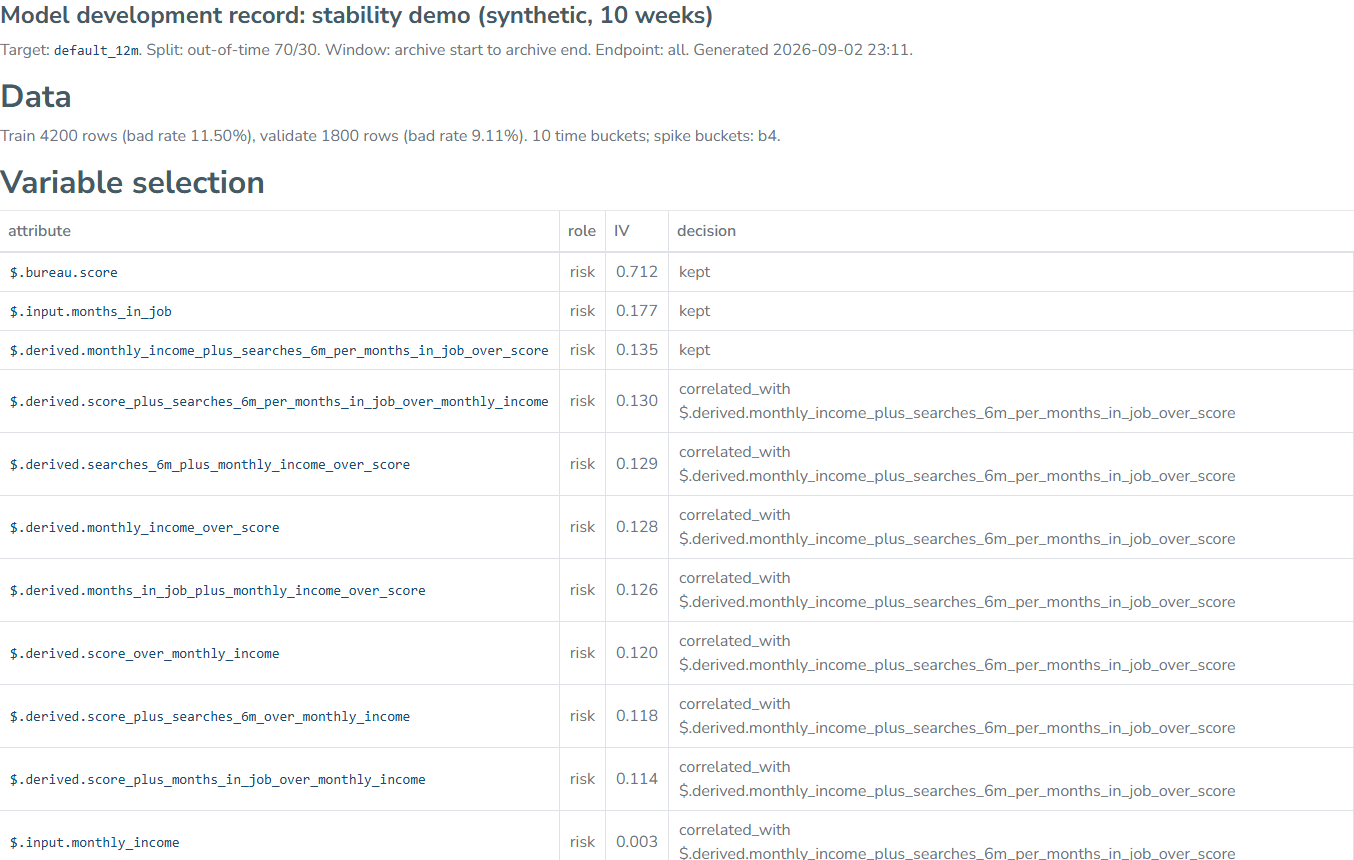
What it contains
The document begins by identifying the run: its target and, for a recovery, the value treated as a decline; the split, written as "out-of-time 70/30" or "out-of-sample hash 70/30"; the window and endpoint; and the time at which it was generated.
| Section | What it holds |
|---|---|
| Data | Rows and bad rate on each side of the split, and the periods the pool was divided into |
| Variable selection | Every risk candidate with its information value, whether it was kept, and the reason when it was not |
| Segmentations | The product and channel attributes, which are dimensions rather than candidates |
| Strongest correlations | What moves with what, which is the justification for the attributes dropped as redundant |
| Binning | Each characteristic's bins, their evidence, and their stability verdicts |
| Scorecard | The fitted points per bin, with the fit's performance on both sides of the split |
| Cutoff sheet | The sweep, at the approval points a reader asks for first |
| Cutoff by segment | The same sweep inside each segment |
| Derived quantities | The ratios that were built and what they are made of |
| Recovered policy | For a recovery run: the knock-outs, eligibility lines, cutoff and the agreement they reach |
| Top mined findings | The candidate effects with their validated numbers |
| Mix vs rate | Whether a change in the bad rate came from a different book or from the same book performing worse |
| Provenance | The settings behind every number above |
Mix vs rate needs particular attention because, when the bad rate changes between periods, this section separates the share of the movement caused by a changed population from the share caused by the same population performing worse. That distinction helps prevent a cutoff from being tightened merely because the channel mix has shifted.
Your overrides are in it
When you drop variables or review the binning, the header records Analyst overrides and identifies the parts of the analysis you changed. The record therefore keeps your version distinct from the machine's version, while also showing that the original machine-generated version existed.
That is why the document is written as a by-product of the analysis rather than assembled later as a report: a validator needs to see not only what the model is, but also who made each decision and the evidence used to make it.
Provenance
The final section makes the record reproducible by naming the analysis and parameter versions, stating whether anything differed from the shipped defaults, and listing every parameter the run actually read together with its value and meaning:
| parameter | value | meaning |
|---|---|---|
mining.train_fraction | 0.7 | share of rows that train; the rest validate |
binning.fine_bins | 20 | fine bins before merging |
scorecard.pdo | 40 | points that double the odds |
Repeating a run with the same window and parameter values reproduces the same record, which gives someone checking the work a basis for verification rather than requiring them to take the result on trust.
Keeping a copy
Because the record is Markdown, you can copy it into your model documentation, validation pack or ticketing system, and the pipeline retains a copy with the run so that an older analysis remains readable exactly as it was written, including the overrides in force at the time.
What it does not claim
The record describes an analysis rather than an approval: it states what the data supports under the named settings and across the named window, but it does not certify a model or claim that the fitted population resembles the population on which you will make decisions next quarter. The stability sections are there so that a reader can make that assessment for themselves.