Choosing credit bureaus in Latin America by country
Across Latin America, private bureaus and public registers hold credit data, with a public register present in most countries and private sources ranging from none found in Venezuela to five in Chile. That spread matters to a regional contract because the same groups owning most bureaus do not make the national systems interchangeable. Argentina’s central bank gives every lender its register through a free API, while Paraguay makes bureau membership a reporting commitment: signing means sending your portfolio there. You must decide what the public register and each bureau contract add in each country.
Identify bureau sources by country
Assess a regional bureau agreement as one commercial relationship against each country’s launch needs. Equifax, TransUnion and Experian appear across many markets, but their presence does not mean one agreement covers every country. But the number and identity of sources vary by country, so check which local bureau or register your team can use in each market.
Start by asking which private bureaus and public registers are identified in each country on your plan.
| Country | Private bureaus found | Public register |
|---|---|---|
| Mexico | Buró de Crédito, Círculo de Crédito | None in this set |
| Guatemala | TransUnion, Infornet, Digidata | SIB, supervised lenders only |
| El Salvador | Equifax, TransUnion, INFORED | SSF Central de Riesgos |
| Honduras | TransUnion, Equifax | CNBS Central de Información Crediticia |
| Nicaragua | TransUnion, SinRiesgos | SIBOIF, last month's balances |
| Costa Rica | Equifax (Datum, Teletec), TransUnion, SICRE | SUGEF CIC and CICOC |
| Panama | APC Buró | None in this set |
| Dominican Republic | TransUnion, Equifax Dom, Acierta, Kalifika | Superintendencia de Bancos |
| Country | Private bureaus found | Public register |
|---|---|---|
| Colombia | DataCrédito, TransUnion, Procrédito | None in this set |
| Venezuela | None found | SUDEBAN SICRI, for banks |
| Ecuador | Equifax, Aval Buró | Superintendencia de Bancos |
| Peru | Equifax, Sentinel, DataCrédito, Xchange | SBS Central de Riesgos |
| Bolivia | INFOCENTER, INFOCRED | ASFI Central de Información Crediticia |
| Brazil | Serasa, Boa Vista, Quod, SPC Brasil | Banco Central SCR |
| Chile | DICOM, TransUnion, Experian, Boletín Comercial | CMF REDEC |
| Argentina | Veraz, Nosis, Fidelitas | BCRA Central de Deudores, free API |
| Paraguay | Equifax, BICSA, Criterion, Infomercio | BCP Central de Riesgo Crediticio |
| Uruguay | Clearing de Informes (Equifax) | BCU Central de Riesgos Crediticios |
There is no single bureau setup for the region. The country list identifies no private bureau operating in Venezuela, one in Panama and Uruguay, and four private sources in Chile alongside its public register.
The bureau owners include Equifax, TransUnion and Experian, local owners named in the country list, and the parties to Mexico’s 2026 ownership deals.
Check whether you can use the public register
A public register belongs in your source review only if your institution can access it and its records suit the decision you need to make. Access, history and coverage differ, so confirm those before putting a register into the launch plan.
Argentina’s central bank register is free through a public API with no authentication and includes twenty-four months of history. Chile’s REDEC includes reported obligations, paid and unpaid, with the applicant’s consent. Peru’s SBS register keeps defaults with no time limit, while the private bureaus there keep defaults for five years after payment.
Access can depend on the type of institution. Guatemala’s SIB risk register is open to supervised lenders for credit analysis. In Costa Rica, supervised lenders use the CIC, while non-supervised lenders registered with SUGEF use the CICOC.
Read the reporting duty before signing
A bureau contract can require you to contribute data as well as pay for access. In Paraguay, you must report positive and negative data to every bureau you sign with.
That changes the decision from “What information will this source return?” to “What portfolio must we report, and to how many agreements?” Put the reporting duty beside the price and access terms before you sign.
Test a second bureau on your applicants
Where more than one bureau is available, a second source earns its place only if the information it adds is worth the calls and the effect on applicants. A second bureau may identify more risky borrowers, but it may also flag good applicants. Its hit rate, the errors it makes, the call price and your loan economics all matter.
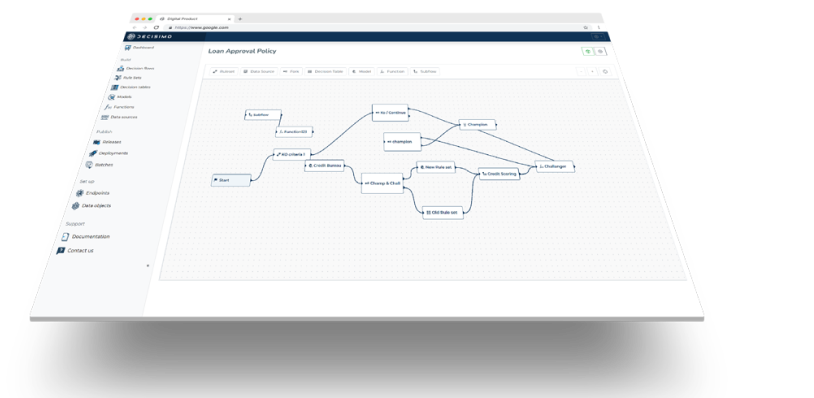
Compare the first source on your own applicants, then isolate the applicants with no file and test the second source on that group. Record the additional files and the risk outcomes you observe. The data source waterfall tool compares four options: A only, B only, B only when A has no hit, and both. It compares them using the price per call, the loss per bad loan and the profit per good one. Your applicant results decide which option makes sense for your book.
Decisimo’s data source documentation describes how a data source connects to any REST API or SOAP web service and how a failed call routes to a fallback branch like any other data source error.
Set the launch decision before the first application
Set the country-specific requirements for each launch before the first application. Read the country’s page for its consent, decline and record rules, then decide how a bureau result can affect approval or decline under your policy.
Chile’s REDEC uses applicant consent. Guatemala requires the person’s authorisation for private bureau information, and El Salvador’s authorisation names the bureau on its own document. These differences can change what your team must have in place before it makes an inquiry.
Use this sequence to decide what to sign and what must be ready for each launch.
- For each country, identify its public register and confirm whether your institution can access it and whether its records serve the decision you need to make.
- List the private bureaus found in each country and who owns each.
- Read each agreement for reporting duties, including whether you must provide positive and negative data.
- Where more than one bureau is available, compare them on your own applicants and assess calling the second only when the first returns no file.
- Read the country’s page for its consent, decline and record rules before the first application.
Questions about credit bureaus in Latin America
How many credit bureaus are there in Latin America?
There is no single regional count. The eighteen countries listed here range from no private bureau found in Venezuela to four private sources in Chile, which also has a public register.
Which companies own the credit bureaus in Latin America?
Equifax, TransUnion and Experian appear across many countries, alongside local owners and operators.
Which Latin American country has only one credit bureau?
Panama and Uruguay each have one private bureau identified: APC Buró in Panama and Equifax’s Clearing de Informes in Uruguay.
Is there a credit bureau in Venezuela?
No private bureau was found operating. SUDEBAN keeps a register based on banks’ data for banks.
Which central bank credit register is free?
Argentina’s Central de Deudores is free through a public API with no authentication.
Can a fintech read the public credit register?
It depends on the country and the register. Argentina’s API has no authentication, Guatemala’s SIB register is limited to supervised lenders, and Costa Rica has separate registers for supervised and registered non-supervised lenders.
Who owns the credit bureaus in Mexico?
For individuals, Buró de Crédito is run as Trans Unión de México. After five banks sold, TransUnion was reported to hold 94% in July 2026. For businesses, it is run as Dun & Bradstreet. Equifax agreed on 7 July 2026 to buy Círculo de Crédito, with closing expected in Q4 2026.
Which Latin American countries have two private bureaus?
Mexico, Honduras, Nicaragua, Ecuador and Bolivia each have two private bureaus listed.
Is Brazil's Cadastro Positivo opt-in?
No. Brazil’s Cadastro Positivo is opt-out.
Which public register shows only current balances?
Nicaragua’s SIBOIF report shows only current balances.
Do I have to report my loans to the bureau?
In Paraguay, you must report positive and negative data to every bureau you sign with.
How long does Peru keep a default?
The SBS register has no time limit, while private bureaus keep defaults for five years after payment.
Is there a credit bureau law in Guatemala?
Guatemala has no specific law governing credit bureaus.
How many credit bureaus are licensed in the Dominican Republic?
Four credit bureaus are listed in the Dominican Republic.
Which credit bureaus operate in Colombia?
DataCrédito, TransUnion and Procrédito are listed in Colombia.
Does a credit check authorisation have to name the bureau?
In El Salvador, the authorisation names the bureau on its own document.
Who owns Boa Vista in Brazil?
Equifax owns 80% of Boa Vista.
What does Chile’s REDEC include?
It includes reported obligations, paid and unpaid. The applicant’s consent is required.
