Choosing a credit bureau for lending in Bolivia
Bolivia’s credit data is held by ASFI’s CIC and two licensed private bureaus, Infocenter and Infocred. Choosing one private bureau does not remove the CIC from the consumer credit check, which requires queries on both borrower and spouse. The confidential CIC report requires the client’s express authorisation, and the CPOP report comes only after the capacity-of-payment stage. Which bureau report adds to the methodology your board approves, given those requirements and that sequence?
The CIC and a private bureau are separate sources
For salaried consumer credit, both the CIC and a private bureau must be queried for the borrower and spouse. ASFI runs the CIC, the Central de Información Crediticia. It records payment history and indebtedness reported monthly by supervised entities. Queries go through Supernet, ASFI’s network.
ASFI’s register lists two licensed private bureaus, INFOCENTER and INFOCRED.
In 2018, ASFI instructed INFOCENTER and INFOCRED to collect information from loan and pawn houses and add it to the databases financial intermediaries consult.
| Source | Run by | What it carries | Access |
|---|---|---|---|
| Central de Información Crediticia | ASFI | Payment history and indebtedness reported monthly by supervised entities | Supernet, with the client's express authorisation for the confidential report |
| INFOCENTER | Buró de Información INFOCENTER S.A. | Credit information | Contract |
| INFOCRED | INFOCRED BI S.A. | Credit information | Contract |
Information on debtors in execution or whose debts have been written off is not confidential under Ley 393, art. 474.
Put authorisation and capacity checks in the right order
Get the required authorisations before you read the reports. ASFI’s CIC regulation says the confidential report may be used only with the client’s express authorisation.
ASFI Circular 270/2014 requires financial entities to obtain the applicant’s authorisation and check identity details against SEGIP, Bolivia’s Registro Único de Identificación, at the entity’s cost. The CIC records the CI number of nationals and the DEI of foreigners. Because the CIC and private bureaus rely on identity details, a wrong cédula number can return the wrong file, or no file, for the borrower or spouse.
The applicant may use the action under Constitution art. 130 and Ley 393 art. 477 to know, object to, correct or delete data held about them.
For salaried consumer credit, first assess capacity of payment. Keep monthly debt service, including other direct obligations, at or below 25% of average net pay over the last three months. The CPOP report is a CIC report that may be read only after the application has passed this capacity stage.
Use a regular salary over a period your entity defines for salaried consumer credit. You may add the spouse’s salary, in which case the spouse becomes a co-debtor, which is why the spouse is queried. A self-liquidating guarantee lifts the 25% limit. For independent workers, use historical financial information showing that income recurs and is stable.
If ASFI supervises your entity and it does not have these policies, it holds a generic provision of 3% on its housing, consumer and microcredit portfolio.
| Step | The duty | Where |
|---|---|---|
| Identity | Authorisation and a check against SEGIP | ASFI Circular 270/2014 |
| Before the confidential report | The client's express authorisation | RNSF CIC regulation, Secc. 6 art. 5.a |
| The analysis | CIC and bureau queries on borrower and spouse, debt service at most 25% of net pay | RNSF L3 T2 Cap. IV |
| The CPOP report | Only after the capacity-of-payment stage | RNSF CIC regulation, art. 5.d |
| The methodology | Approved by the Directorio | RNSF L3 T2 Cap. I |
Make each report matter in the approved methodology
Your entity sets its evaluation and rating methodology, and the Directorio, or board, approves it and every later change.
The methodology may be based on mathematical, statistical or other foundations. A scorecard built on CIC and bureau data is one form it can take, and the Directorio approves it.
Use the CIC’s payment history and indebtedness, along with the information returned by the private bureau, in the assessment. Write into the methodology how that information affects the rating and decision.
Choose the private bureau by what it adds to your decisions
Compare Infocenter and Infocred using the same applicants and your approved methodology. The contract price matters, but so does whether a source returns information that changes or supports the credit decision.
For each applicant in the comparison, record whether the bureau returns a file, what relevant information it adds, and whether that information changes or supports the assessment under your methodology. Compare those results against the CIC and against the decision made using the first private bureau alone. Include the call cost, and account for the good and bad applicants each source would flag.
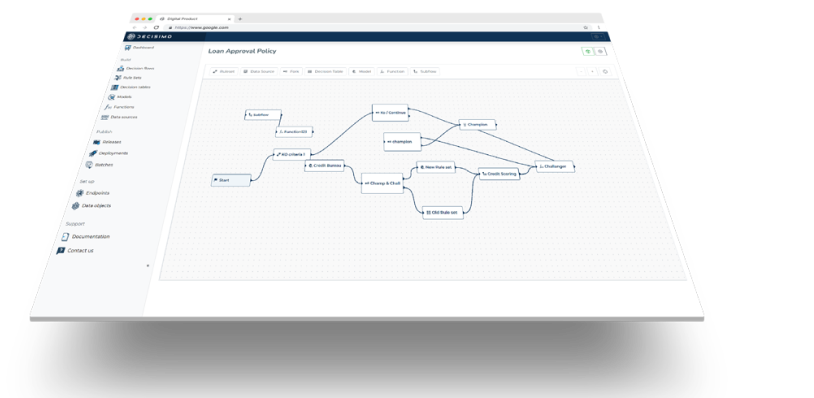
Test four arrangements: either bureau alone, both on every applicant, and the second bureau called only when the first returns no file. The data-source waterfall tool compares these options using hit rate, the applicants each source flags, call price, loss per bad loan and profit per good one.
Decisimo’s data-source documentation describes connecting to any REST API or SOAP web service, and a failed call can route to a fallback branch like any other data source error.
Replace the one-query plan with this procedure
A single-query approach leaves unresolved whether to check the spouse, whether to query the CIC, and in what order to run the checks. Put this procedure into the methodology before the product goes live:
- Verify the applicant’s identity against SEGIP, with the applicant’s authorisation.
- Obtain the client’s express authorisation before reading the CIC confidential report.
- For consumer credit to a salaried person, query the CIC and a private bureau on the borrower and the spouse.
- Use the returned payment history, indebtedness and other relevant information in your methodology.
- Check monthly debt service, including other direct obligations, against the 25% limit on average net pay over the last three months. Read the CPOP report only after the capacity-of-payment stage.
- Record how each source’s findings affect or support the assessment, and take the methodology and every later change to the Directorio for approval.
- Compare Infocenter and Infocred on your own applicants, including the information each adds and its cost. Choose whether to call the second only when the first returns no file based on the decision value and cost you measure.
Questions about credit bureaus in Bolivia
How many credit bureaus are there in Bolivia?
There are two licensed private bureaus: INFOCENTER and INFOCRED. The CIC is a separate register run by ASFI.
What is the ASFI Central de Información Crediticia?
It is ASFI’s register of payment history and indebtedness reported monthly by supervised entities. CIC queries go through Supernet.
Do I need the applicant’s authorisation to check the CIC?
Yes. Obtain the client’s express authorisation before reading the CIC confidential report.
Do I have to check the spouse?
For consumer credit to salaried persons, the required analysis includes CIC and private-bureau queries on the borrower and spouse.
Do Bolivian credit bureaus carry loans from pawn and loan houses?
Yes. In 2018, ASFI instructed the two licensed bureaus to collect information from loan and pawn houses and add it to the databases financial intermediaries consult.
May a scorecard be used in the credit methodology?
Yes. A scorecard based on mathematical, statistical or other foundations may form part of the credit methodology, subject to approval by the Directorio.
What is the debt service limit for a salaried consumer loan?
Monthly debt service, including other direct obligations, is limited to 25% of average net pay over the last three months. A self-liquidating guarantee lifts the limit.
What is the CPOP report, and when can I read it?
It is a CIC report, and you may read it only after the application has passed the capacity-of-payment stage.
How do I verify an applicant's identity in Bolivia?
Obtain the applicant’s authorisation and check identity details against SEGIP at the entity’s cost. The CIC records CI numbers for nationals and DEI for foreigners.
Does a self-employed applicant need a different analysis?
For an independent applicant, use historical financial information showing that income recurs and is stable.
How long does a written-off debt stay on record in Bolivia?
Written-off debtors remain on record for 20 years, after which the right to be forgotten applies.
What happens if the credit policy lacks the salaried consumer rules?
An entity supervised by ASFI that lacks these policies holds a generic provision of 3% on its housing, consumer and microcredit portfolio.
Does Bolivia have a data protection law?
As of October 2026, Bolivia has no general personal data protection law or data protection authority. The Constitution and Ley 393 provide rights to know, object to, correct or delete personal data.
Can I include the spouse’s salary?
Yes. If you add the spouse’s salary, the spouse becomes a co-debtor, which is why the spouse is queried.
