Choosing a credit bureau in Honduras
In Honduras, TransUnion and Equifax are the licensed credit bureaus, and their records may include data from supervised and non-supervised lenders. The register you consult depends on the institution: the CNBS's CIC applies to entities it supervises, while cooperatives use CONSUCOOP's SIF. A clean file can reflect reporting windows: negative consumer-loan data appears for only three months after full repayment, and the file omits balances of US$200 or less once they are past 90 days overdue. You must decide how those limits shape your rules and provide the authorisation the bureau checks.
Identify the register your institution needs
There are two licensed private credit bureaus in Honduras: TransUnion Honduras and Equifax Honduras. The register you read alongside a bureau depends on your institution. If CNBS supervises you, the Comisión Nacional de Bancos y Seguros (CNBS) runs the Central de Información Crediticia (CIC), which consolidates credit data from supervised institutions. If you are a cooperative, CONSUCOOP’s Sistema de Inclusión Financiera (SIF) has a module showing a member’s loans at other cooperatives. The private bureaus may hold data from both supervised and non-supervised lenders.
| Source | Run by | What it carries | Access |
|---|---|---|---|
| Central de Información Crediticia | CNBS | Supervised institutions' borrowers, co-borrowers and guarantors | The person's authorisation |
| TransUnion Honduras | TransUnion | Supervised and non-supervised lenders' data | Contract, authorisation |
| Equifax Honduras | Equifax | Supervised and non-supervised lenders' data | Contract, authorisation |
| SIF vinculación crediticia | CONSUCOOP | Members' loans at other cooperatives | Cooperatives, the member's prior authorisation |
The CNBS CIC carries information from institutions CNBS supervises. A private bureau can draw on a broader set of lenders. A clean result shows that no negative entry is currently visible under that source’s reporting rules.
Treat clean files as limited evidence
A clean bureau file means there is no negative entry currently visible under that source’s reporting rules. It shows only what those rules currently disclose, not a complete repayment history.
Negative data on a consumer loan may show for up to three months after full repayment. Balances of US$200 or less more than 90 days past due are omitted from the report. So a thin applicant can pass a cutoff on a clean file after a recent repayment, or while a small arrear is missing from the report.
If your policy treats that result as a complete repayment history, it can approve an applicant on incomplete evidence. The approval brings the loan onto the book, and the missing information may become a loss later.
Set cutoffs by debt type and status
| Step | The rule | Where |
|---|---|---|
| Before the pull | The person's authorisation, checked by the bureau | Reglamento art. 21, CNBS CIC |
| Bureau data abroad | Only to users | Reglamento art. 22 |
| Negative data | Up to 3 months after repayment on consumer loans | Reglamento art. 5 |
| Unpaid debts | 2 years up to US$3,000, 5 years above | Reglamento art. 5 |
| A dispute | Lender answers within 4 business days | Reglamento arts. 39, 40 |
For consumer and housing loans, negative data may remain visible for up to three months after full repayment. For commercial loans and microcredit, it disappears on full repayment unless the debt was repaid through refinancing. Unpaid debts of US$3,000 or less remain for two years, and debts above US$3,000 remain for five years. Those periods run from 90 days past due, or 180 days for housing loans. Positive data is shown permanently.
Control bureau access and disputed records
Keep the applicant’s authorisation available for the bureau to verify before you query. Bureaus may collect credit data without the person’s authorisation under article 13, but a query requires the person’s authorisation under article 21. The authorisation remains valid while the legal relationship exists. Cooperatives checking a member’s loans at other cooperatives through the SIF module need the member’s prior authorisation.
Check the information-exchange contract before data starts moving. Bureau data flows under a contract to exchange information, and overseas transfers are permitted only to people or companies that are users.
Honduras has no general data protection law. Article 182 of the Constitution provides for habeas data. No rule on automated credit decisions was found, and the CNBS Normas expressly permit credit scoring.
The bureau forwards a claim to you within three business days and marks the record as disputed in the meantime. Answer the claim within four business days after it is forwarded. That deadline affects whether an inaccurate record continues to influence a decision.
Test whether a second bureau adds value
Compare TransUnion and Equifax on your applicants, and decide whether a second contract adds coverage worth its call cost.
Compare the same applicants under four options: the first bureau alone, the second alone, the second only when the first has no file, and both bureaus. For each option, count which approvals and declines change, how many good and bad applicants each source flags, and what the calls cost. Then weigh those changes against the price per call, the loss per bad loan and the profit per good one. The second call must add value on your book.
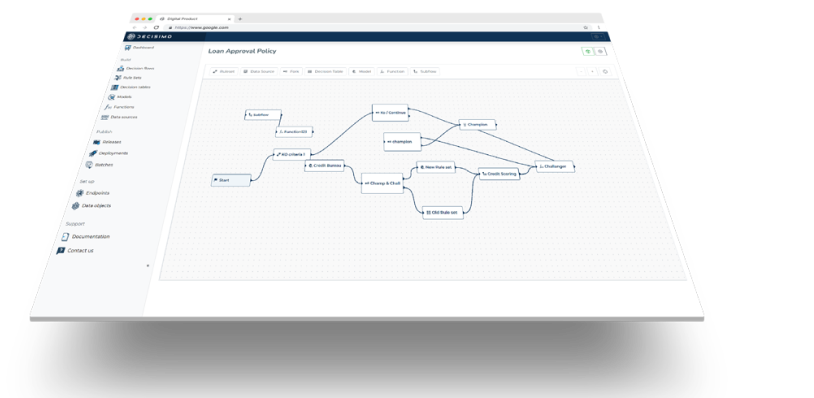
Use your own applicant outcomes and contract prices to decide whether a second bureau earns its place, and whether to call it only after a no-hit from the first. The data source waterfall tool compares these call strategies using hit rates, flagged good and bad applicants, call prices, loss per bad loan and profit per good one. If you need more than one source in a decision flow, Decisimo’s data source documentation describes connections to any REST API or SOAP web service, and explains how a failed call routes to a fallback branch like any other data source error.
Apply the policy to a thin applicant
For an applicant who passes on a clean file, make sure the source, authorisation and reporting limits are reflected in the policy.
- Identify the register that applies to your institution: the CNBS CIC if CNBS supervises you, or CONSUCOOP’s SIF module if you are a cooperative checking a member’s loans at other cooperatives.
- Obtain the applicant’s authorisation before the query and keep it available for the bureau to verify. For a cooperative SIF query, obtain the member’s prior authorisation.
- Set the policy with the reporting limits in view. A repaid consumer debt may show for up to three months, and balances of US$200 or less more than 90 days past due are omitted.
- Keep bureau data within the information-exchange contract as a user. Transfer it abroad only to people or companies covered as users.
- Answer a disputed-record claim within four business days after the bureau forwards it.
- Compare both bureaus on the same applicants, first alone and then with the second called only after a no-hit. Select the sequence whose changed approvals and declines justify its call cost against the loss per bad loan and profit per good one.
Questions about credit bureaus in Honduras
How many credit bureaus are there in Honduras?
There are two licensed private credit bureaus: TransUnion Honduras and Equifax Honduras.
What is the CNBS Central de Información Crediticia?
It is the CNBS register that consolidates credit data from supervised institutions on borrowers, co-borrowers and guarantors. Individuals can get their own CIC report through the CNBS’s online service.
How long does a debt stay on a credit report in Honduras?
It depends on the debt type and status. Negative data on a repaid consumer or housing loan may remain for up to three months after repayment.
Do I need the applicant’s authorisation to pull a report?
Yes. The bureau must verify that you have the person’s authorisation to consult the information.
Where do cooperatives check a member’s other loans?
CONSUCOOP’s SIF has a module showing a member’s loans at other cooperatives. Cooperatives using that module obtain the member’s prior authorisation before checking.
Does a Honduran bureau need the applicant's consent to collect their data?
A bureau may collect credit data without the person’s authorisation under article 13, but it must verify the person’s authorisation before a query under article 21.
Can bureau data be sent outside Honduras?
Bureau data may be transferred abroad only to people or companies that are users.
Is credit scoring allowed in Honduras?
The CNBS Normas expressly permit credit scoring.
How can an applicant dispute an entry on a bureau report?
The applicant can submit a claim to the bureau. The bureau forwards it to the lender within three business days and marks the record as disputed in the meantime.
Does Honduras have a data protection law?
Honduras has no general data protection law. Article 182 of the Constitution provides for habeas data. No rule on automated credit decisions was found, and the CNBS Normas expressly permit credit scoring.
