How credit card underwriting sets approval and limits
The application is on your screen with a suggested card limit and a place in the review queue, even though the score would have approved it. Its bureau file is clean, but thin, and the system has not shown how it produced the amount. You have to make the limit decision from inside the underwriting policy, not simply accept a figure because it appears beside the application. Then your colleague asks whether the proposed amount would even pass the payment test.
Underwriting decides whether to issue the card and at what limit
Credit card underwriting decides whether to issue a card and what credit limit to set. It reads bureau information, including the credit score, accounts, balances, limits and missed payments, alongside income, other debt payments and the issuer’s own data. The outcome is an approval with a limit, a decline or a referral.
On a revolving card, the cardholder can draw the whole limit, so that figure sets the lender’s exposure. Issuers often begin with an income multiple or a score band, then test the amount against affordability and, in some markets, a repayment rule or cap.
A good score can still rest on little bureau history. With a thin file, many issuers refer the application to an underwriter or set a low starting limit rather than rely on the score alone.
The payment test sets the worked applicant’s limit
The worked applicant’s income multiple gives a limit of 6,000, but the payment test brings it to 4,000 in all six market settings. The credit card limit calculator compares a behaviour limit, an affordability limit and the market rule, then takes the lowest. For this applicant, monthly net income is 3,000 and other debt payments are 1,000.
| Market | Behaviour limit | Affordability limit | Market rule allows | Limit |
|---|---|---|---|---|
| No market | 6,000 | 4,000 | no cap | 4,000 |
| United States | 6,000 | 4,000 | 4,000 (minimum payment test) | 4,000 |
| United Kingdom | 6,000 | 4,000 | 5,382 (repaid over 36 months at 20%) | 4,000 |
| Australia | 6,000 | 4,000 | 5,382 (repaid within 3 years at 20%) | 4,000 |
| France | 6,000 | 4,000 | 7,549 (repaid within 60 months above 3,000) | 4,000 |
| Belgium | 6,000 | 4,000 | 9,545 (brought to zero within 96 months) | 4,000 |
Compare the three limits before you settle the amount
The affordability limit sets the worked applicant’s result because it is the lowest of the three figures. The income multiple starts at 6,000, while the payment test leaves room for a 4,000 limit after accounting for other debt payments. The market rule is higher in the United Kingdom, Australia, France and Belgium, so it would allow more for this applicant. The United States minimum-payment test produces the same 4,000 result.
The market rules use different tests. The cited United Kingdom text requires the full limit to be repayable over a reasonable period. The Australian text tests repayment within three years. The French and Belgian texts set repayment periods that vary by amount or rate. The calculator uses these market-rule examples. Check the current text before relying on a market rule.
Grade applications by policy and refer thin files
Use policy to decide which applications approve, decline or need an underwriter. The example’s rule set approves a score of 680 or more with debt to income under 35%, refers a score from 600 to 679 or debt to income from 35% to 45%, and declines other cases. Fewer than two bureau accounts turns an approval or referral into a thin-file referral. The example sets its approval, referral and decline thresholds at these figures. The broader consumer lending policy article covers how lenders define such rules.
| Applicant | Bureau score | Debt to income | Bureau accounts | Grade | Reason |
|---|---|---|---|---|---|
| Established | 745 | 22% | 6 | approve | |
| Thin margin | 640 | 38% | 4 | refer | thin margin |
| Thin file | 700 | 20% | 1 | refer | thin file |
| Below policy | 560 | 50% | 3 | decline | below policy |
The applicant with a score of 700 and debt to income of 20% has one bureau account, so the policy refers the case. A thin-file score offers less bureau history to support approval than a score backed by more history.
Run the limit rules with the application
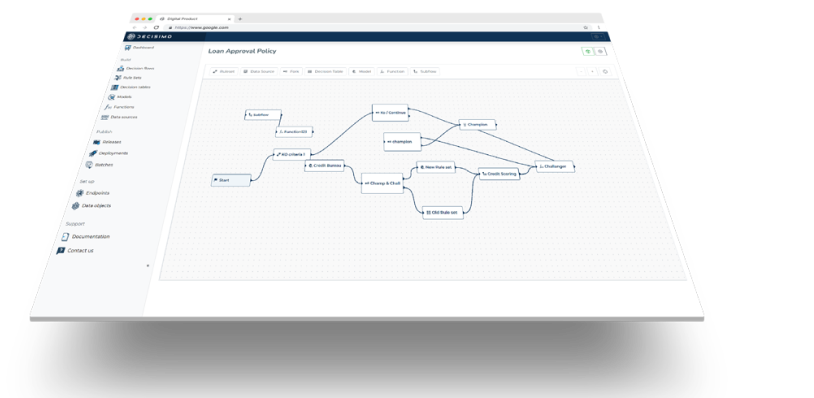
After policy grades the application, the Credit limit task can calculate the amount using monthly income and other debt payments. The case design puts that calculation alongside the policy and decision tasks. This example was built on Decisimo’s test environment, and its rules ran on the example applicants.
For the applicant with 3,000 monthly income and 1,000 in other payments, the behaviour limit is 6,000, the remaining monthly room is 200, the affordability limit is 4,000 and the final limit is 4,000. With income of 5,000 and other payments of 400, the 10,000 behaviour limit sets the result because affordability allows 32,000. With income of 2,000 and other payments of 790, only 10 remains for payments, the affordability limit is 200, and the case falls below the example’s 500 minimum for a card.

Show the underwriter how the amount was reached, alongside the final amount.
Give the underwriter the referral reason and limit figures
Let the automatic decision take clear approvals with a positive limit and clear declines. Refer the other applications to an underwriter. In the example, the applicant with a score of 700 is referred because the file has one bureau account. The underwriter sees the score, the referral reason and the three limit figures, then decides both the outcome and the limit.
The underwriter task asks for a decision to approve, approve at a lower limit or decline, plus a limit and a note. Its review information carries the current case data. The automated underwriting decision and human review can sit alongside the policy and limit calculation.

The Flow connects the tasks that read and write each part of the case.

Keep assessing limits after the card is issued
Limit decisions continue after issuance as utilisation and payment behaviour accumulate. In the calculator’s example, after six months on book, an existing limit rises by 50% when utilisation is at least 70% and at least half of statements are paid in full. It rises by 25% when utilisation is at least 30%. The example cuts the limit by 50% after two missed payments, also after six months on book.
The calculator shows these increase and cut rules as an example. Set increase and cut rules for your own book, then apply them to card behaviour, utilisation and missed payments.
Put the limit and referral rules into the case
Return to the thin-file application in the review queue. Its score is 700, but one bureau account sends it to an underwriter. Put the payment test and referral reason in front of the person making the decision, then build the case in this order:
- Write the card policy on bureau information and income. Define what approves, declines and is referred, and refer thin files.
- Write the income multiple, payment test and your market’s cap or repayment rule as three limit figures. Set the limit to the lowest figure.
- Put a typical applicant from your own book through the calculator for your market, and identify which figure binds.
- Let the automatic decision take only clear approvals with a limit and clear declines.
- Give referred applications an underwriter task whose review information carries the score, referral reason and three limit figures. Ask the underwriter for both the decision and the limit.
- After issuance, run the same rules for limit increases and cuts based on behaviour, utilisation and missed payments.
Questions about credit card underwriting
What is credit card underwriting?
It is the decision on whether to issue a card and what limit to set, using bureau information, income, other debt payments and the issuer’s own data. Define approval, decline and referral in the card policy.
How is a credit card limit decided?
Compare the behaviour limit, affordability limit and applicable market rule. The lowest figure sets the limit. Check which one binds for a typical applicant in your book.
What is the credit card underwriting process?
Read the application information, grade it against policy, calculate the limit, decide clear cases automatically and refer applications needing review to an underwriter. Give the underwriter the referral reason and limit figures.
Why are thin-file card applications referred to an underwriter?
A good score can be based on little bureau history, so the score alone may not give the issuer enough basis to approve. Refer the case with its score, reason and calculated limit available for review.
Do regulators cap credit card limits?
Sometimes. Rules differ by market, and they may set repayment tests or periods or cap limits by income. Check the current text before relying on a rule.
How are credit card limits increased or cut after the card is issued?
Issuers may increase limits for cardholders who use and repay the card, and cut limits after missed payments. Set rules for your own book and apply them to post-issuance behaviour.
