How to choose a credit bureau in Brazil
Brazil’s credit data is held by four private bureaus registered for Cadastro Positivo and by the Banco Central’s public SCR register. The private bureaus are owned by Experian, Equifax, the five largest banks and the retailers’ confederation. Since Cadastro Positivo became opt-out, they hold positive payment histories on people who never asked to be included. An applicant may ask you for the main criteria behind a decision and for a review if it was made only by automated means. That leaves you choosing bureaus for their data feeds and building those rights into your flow.
Brazilian bureau records need separate rules
A blanket decline on any negative record can seem like a straightforward rule. A decision is needed before launch, and provider and price can look like the main questions.
But Brazil’s Cadastro Positivo is an opt-out register. A gestor may add payment data without the person’s consent, provided it notifies them within 30 days and gives them a way to cancel. That positive register is separate from the negative registers.
Access also depends on what you request. A score may be shown without consent, but detailed credit history requires the person’s specific prior authorisation. The applicant may ask for the main criteria considered in a risk analysis and request review of a decision made exclusively by automated means.
So the rule from another market cannot simply treat every bureau result as a blacklist entry. First distinguish the source and information you are using, then decide how each can affect the application.
Private bureaus and the SCR serve different roles
Brazil has four private gestores of the Cadastro Positivo: Serasa, Boa Vista Serviços, Quod and SPC Brasil. If you are comparing credit bureaus, ownership is useful context, but it does not tell you which source performs best on your applicants or whose payment data it uses.
| Bureau | Owner | Since |
|---|---|---|
| Serasa | Experian | Cadastro Positivo gestor since 2019 |
| Boa Vista (SCPC) | Equifax, 80%, with the São Paulo trade association | Acquired Aug 2023 |
| Quod | Banco do Brasil, Bradesco, Caixa, Itaú, Santander, with LexisNexis as minority | Created 2017 |
| SPC Brasil | CNDL, the retailers' confederation | Cadastro Positivo gestor since 2019 |
| SCR | Banco Central do Brasil | The public register |
The SCR is different. It is the Banco Central do Brasil’s public credit information system, separate from the private bureaus. Some institutions, including SCDs, SEPs, financeiras and cooperatives, must report credit operations to it. Consulting the SCR requires the client’s specific authorisation, including an extension to institutions that buy the credit or take it as collateral.
Run the same applicants’ files through your bureau-based rule with and without the SCR read. Compare which applicants each version approves and the resulting risk costs. SCR query permission is distinct from permission to access detailed Cadastro Positivo history.
Open Finance, under Res. Conjunta 1/2020, lets an applicant share credit-operation data with your team at application with the client’s consent. At the five-year mark in February 2026, more than 154 million active consents were reported.
Permissions and applicant review shape bureau decisions
Set access rules by source and by information requested. The score may be shown without consent, detailed history needs the person’s specific prior authorisation, and an SCR query needs the client’s specific authorisation.
| Step | The duty | Where |
|---|---|---|
| Before the SCR pull | The client's specific authorisation | Res. CMN 5.037 art. 12 |
| Before the detailed history | The person's specific prior authorisation | Lei 12.414 art. 4 IV |
| The score | No forbidden inputs | Lei 12.414 art. 7-A |
| After a decision | The main criteria, and review of an automated decision on request | Lei 12.414 art. 5 IV and VI |
| A negative record | Written notice when it is opened, kept at most 5 years | CDC art. 43 |
Your scoring rules also need to exclude inputs prohibited by law, including data unrelated to credit risk and data about social or ethnic origin, health, genetics, sex, beliefs or the exercise of rights. Keep the main criteria considered in each decision so you can provide them on request, and give applicants a route to request review of a decision made exclusively by automated means.
A negative record requires written notice when it is opened, and negative data may be kept for at most five years.
For a practical test of the blanket decline rule, take applications that would have been declined because of a negative entry and replay them with a test rule that refers those cases for review instead. Compare the resulting decisions with the original rule under your existing credit policy. The law sets the applicant’s rights and the record requirements. Your book must show what changing the rule does to approvals and risk.
Your applications reveal the value of each bureau strategy
Choose the contract by counting the additional bad applicants the second bureau’s report identifies, the good applicants it flags, and the cost of each call. A second bureau can identify additional bad applicants, but it can also flag applicants you could have served. The price of the call belongs in the same comparison.
Replay the same applications under four strategies: bureau A only, bureau B only, bureau B only when A has no file, and both bureaus on every application. For each strategy, compare hit rates, the good and bad applicants each source flags, the price per call, the loss per bad loan and the profit per good one. The data source waterfall tool ranks these strategies by net value using those inputs. The answer comes from your applicants and costs, not a provider ranking.
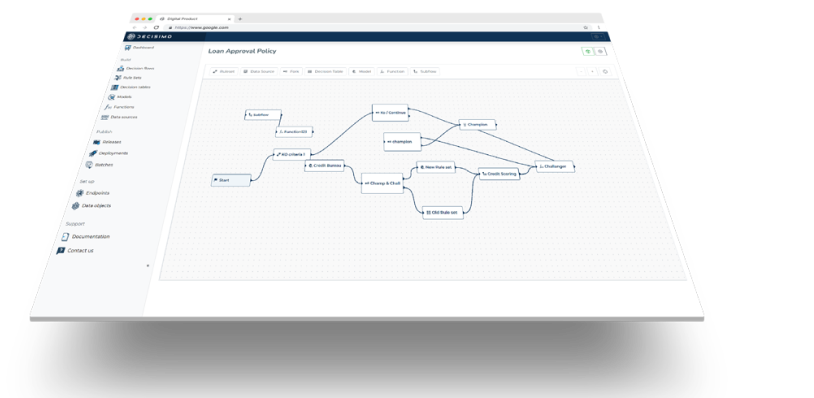
For example, if the second bureau finds additional bad applicants but also flags good applicants, count both effects against the call cost. If it adds no useful files after the first bureau has returned a file, a no-file-only second call may be worth testing against calling both sources every time. Do not assume that result in advance. Decisimo’s data source connects to any REST API or SOAP web service, and a failed call can route to a fallback branch like any other data source error.
Test the launch rule that declines on any negative record against your own book. Replace the assumption with a decision you have tested on your own book.
- List Serasa, Boa Vista Serviços, Quod and SPC Brasil, recording each owner. Keep the SCR separate as the Banco Central do Brasil’s public credit information system.
- Read the SCR entries showing each applicant’s existing credit operations reported by other institutions, then test whether using those entries changes approvals or risk costs. Collect the client’s specific authorisation before a query.
- Use the score where you have no authorisation for detailed history. Obtain the person’s specific prior authorisation before requesting that history.
- Check the score and decision rules for inputs the law forbids.
- Keep the main criteria for each decision and provide a route for an applicant to request review of a decision made exclusively by automated means.
- Send written notice when a negative record is opened, and retain negative data for no more than five years.
- Replay your applications through the four bureau strategies and compare their net value. Sign with a second source, and call it only when the first has no file, if that strategy earns its cost on your book.
Questions about Brazilian credit bureaus
How many credit bureaus are there in Brazil?
Four private Cadastro Positivo gestores were reported as authorised in 2019: Serasa, Boa Vista Serviços, Quod and SPC Brasil. The SCR is a separate public register.
Who owns Boa Vista?
Equifax holds 80% of Boa Vista Serviços, and the remaining 20% is held by the Associação Comercial de São Paulo and other former shareholders.
Who owns Quod?
Banco do Brasil, Bradesco, Caixa, Itaú Unibanco and Santander created Quod. LexisNexis Risk Solutions was reported to have agreed to invest for a minority stake.
What is the Cadastro Positivo?
It is Brazil’s positive credit register, run by private gestores that may add payment data without the person’s consent, subject to notification and the person’s rights.
Do I need consent to see an applicant’s credit history in Brazil?
The score may be shown without consent, but detailed credit history requires the person’s specific prior authorisation, and an SCR query separately requires the client’s specific authorisation.
What is the SCR?
The SCR is the Banco Central do Brasil’s public credit information system for credit operations, separate from the private bureaus. Collect the client’s specific authorisation before consulting it.
How long does a negative record stay in Brazil?
Negative data may be kept for at most five years.
What is Open Finance in Brazil?
Under Res. Conjunta 1/2020, Open Finance lets an applicant share credit-operation data with your team at application with the client’s consent. More than 154 million active consents were reported in February 2026.
