Credit bureaus in Uruguay: what lenders need to check
In Uruguay, Equifax’s Clearing de Informes is the sole private credit bureau, and its report includes the central bank’s register, which misses small credit companies. The familiar view is that an automated decision needs explaining when an applicant asks after a decline, but the required explanation begins at collection. Your notice must identify the valuation criteria, processes and program used, while an impact assessment must precede credit profiling. That leaves you deciding how to use the available information and how to disclose the basis on which your credit decisions are made.
Clearing and BCU records answer different questions
Start with what each source can tell you about an applicant’s reported credit position. Equifax separately sells models and scores alongside its private credit bureau report. Its Informe Clearing includes information from the BCU, the Banco Central del Uruguay. Equifax separately sells models and scores.
The BCU’s Central de Riesgos Crediticios is a monthly register of classifications reported by covered financial intermediaries and credit grantors. Reporting entities submit classifications monthly, within eight business days, and the register does not publish debts held by small EACs and smaller EOCs that do not report.
| Source | Run by | What it carries |
|---|---|---|
| Central de Riesgos Crediticios | Banco Central del Uruguay | Monthly classification 1C to 5 from reporting entities, debts up to 15 years past maturity |
| Clearing de Informes | Equifax Uruguay S.A. de Informes | Informe Clearing with BCU information, models and scores |
The register reports classifications from 1C to 5 and debts up to 15 years past maturity.
Identify which source supports each credit question in your policy. A BCU classification describes the reported borrower record. A score or model is a separate product to assess on its own terms.
The BCU register excludes some smaller credit providers
The Central de Riesgos does not show every non-bank debt. Small credit administration companies (EACs) and smaller other credit grantors (EOCs) do not report to it, so a missing record cannot establish that an applicant has no borrowing with those providers.
Your data duties continue after approval. When a borrower pays a debt listed with a bureau, you must notify the bureau within five business days. The bureau then updates the record within three days, and a paid debt may remain in the data marked as paid.
Uruguay requires scorecard details in the collection notice
Review the application form before launch. Ley 18.331 requires the notice at collection to state the valuation criteria, processes applied and technological solution or program used for automated processing.
Check the notice used in the other market against the scorecard you plan to use. Name the criteria the scorecard applies, the processes that use them and the program used to process the application. Where consent is the basis for processing, present two unticked options, collect free, prior, express and informed consent, and retain proof. The law also provides exceptions, including public-source data and data necessary for a contractual relationship.
If it profiles applicants to predict economic situation, reliability or financial solvency, the URCDP, Uruguay’s data protection authority, requires a data protection impact assessment under Decreto 64/020 before that profiling begins.
| Step | The duty | Where |
|---|---|---|
| At collection | Free, prior, express, informed consent, and the notice with criteria and program | Ley 18.331 arts. 9, 13 |
| Before credit profiling | A data protection impact assessment | Decreto 64/020 art. 6 |
| An automated decision | The right to challenge, and the criteria and program on request | Ley 18.331 art. 16 |
| A debt paid | Tell the bureau within 5 business days | Ley 18.331 art. 22 |
| Old data | Unpaid 5 years, renewable once, paid at most 5 years | Ley 18.331 art. 22 |
If an applicant challenges a significant decision based only on automated processing, they may obtain information about the valuation criteria and program. That right follows the notice you provide at collection.
Test a second source against known repayment outcomes
A second source earns its call when the additional information improves a decision enough to cover its cost. Test it on your own applications with known repayment outcomes. First identify the cases where your current source leaves a specific credit question unanswered. Then compare decisions for those cases with and without the second source.
Compare the loss per bad loan with the profit per good one and the price per call. A source that flags more bad accounts can still reduce value if it rejects too many good customers or costs more than the losses it prevents.
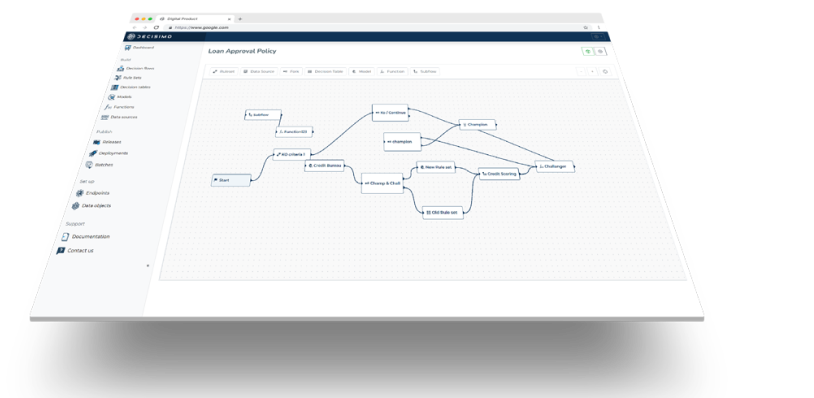
Use the data source waterfall tool to compare A only, B only, B only when A has no hit, or both. If you call more than one source in a decision, Decisimo’s data-source documentation describes how a data source connects to any REST API or SOAP web service, and how a failed call routes to a fallback branch like any other data source error.
The application form needs a Uruguay launch review
Use this sequence to review the application form for a Uruguay launch:
- Read the BCU Central de Riesgos classification and Equifax’s Clearing de Informes. Account for small EACs and smaller EOCs that do not report to the BCU register.
- Where consent is the required basis, collect free, prior, express and informed consent with two unticked options, and keep proof.
- Put the valuation criteria, processes and program used in automated processing in the notice at collection.
- Check whether the scorecard profiles applicants by predicting economic situation, reliability or financial solvency. Complete the data protection impact assessment before that profiling begins.
- Be ready to give an applicant who challenges a significant decision based only on automated processing the criteria and program.
- If a borrower pays a listed debt, notify the bureau within five business days.
- Test a second source on your own applications, compare the loss per bad loan with the profit per good one and the price per call, then use it only when the first source leaves the tested question open.
Questions lenders ask about credit checks in Uruguay
How many credit bureaus are there in Uruguay?
One private bureau has been identified: Equifax’s Clearing de Informes. Uruguay treats these as private databases under data protection law, rather than licensing bureaus as such.
What is the Clearing de Informes?
It is Equifax Uruguay’s private report, and the Informe Clearing includes information from the BCU. Equifax also sells models and scores.
What is the BCU Central de Riesgos?
It is the Banco Central del Uruguay’s monthly register of borrower classifications reported by covered financial intermediaries and credit grantors. Small EACs and smaller EOCs do not report to it.
How long does a debt stay in the Clearing?
Unpaid debt data may remain for five years from incorporation, with one further five-year period if it remains unpaid. Paid debts may remain for up to five years from payment, marked as paid, and Equifax says it keeps paid debts for three years.
What must I tell an applicant about my scorecard?
At collection, the notice must name the valuation criteria, processes and program used for automated processing. An applicant may also challenge a significant decision based only on data processing and obtain information about the criteria and program.
Do I need an impact assessment to use a credit scorecard in Uruguay?
Yes, when the scorecard profiles applicants to predict economic situation, reliability or financial solvency.
How does the BCU classify borrowers?
The BCU classifies borrowers monthly in categories from 1C through 2A, followed by 2B, 3, and 4 to 5.
Which lenders report to the BCU Central de Riesgos?
Financial intermediaries and credit grantors covered by the BCU’s reporting rules report to the register.
Can I process an applicant's data without consent in Uruguay?
Yes, when an exception applies, including data from public sources or data necessary for a contractual relationship. The law does not provide a general legitimate-interests basis.
How often can an applicant see their data for free?
An applicant can access their data free of charge every six months.
How do I verify an applicant's identity remotely in Uruguay?
The applicant can make the request remotely, but you must verify their identity before disclosing their data.
Is the BCU Central de Riesgos public?
Yes. The BCU says the information is publicly consultable.
Must a Uruguayan bureau be registered?
Yes. Every private database is registered with the URCDP.
What must I do when a borrower pays a debt listed with the bureau?
Notify the bureau within five business days. The bureau then updates the record within three days.
How quickly do reporting entities submit classifications to the BCU?
They submit classifications monthly. Reports are due within eight business days.
