Choosing a credit bureau in Colombia
Colombia's credit information sits across three bureaus: DataCrédito, TransUnion and Procrédito. Negative records have a limited life, including a maximum period of four years after payment, so the bureau with the most negative entries cannot offer a permanent account of a borrower's past. The law also requires other grounds alongside negative bureau data in a credit decision. You must choose the bureau whose files fit your segment, then decide how its time-bound report will inform the rest of your assessment.
Negative bureau records cannot decide credit alone
When a decline rule treats any negative bureau entry as a refusal, the bureau with more negative records can appear to offer stronger protection. More records may look like more risk caught before approval, and fewer losses on the book.
That makes the bureau choice seem like a search for the broadest negative file. But bureau selection and the decline rule are connected: the report informs the decision, and the decision determines who receives credit. Before applying that rule in Colombia, establish whether negative bureau information can decide the application by itself.
A credit bureau, commonly called a central de riesgo or, in Ley 1266, an operador de información, supplies information for that decision. The rule you bring to the launch still has to work under Colombia’s law.
Credit decisions must weigh other factors
You cannot base a credit decision only on negative bureau information. Ley 1266 de 2008, as amended, requires you to weigh it with other factors. If you are a financial-system entity, you must give the applicant objective reasons for a rejection in writing when they ask.
Take the rule “any negative bureau record means no approval.” Replace it with a rule that evaluates the report alongside the other factors already in your application and credit policy. For an applicant with a negative entry, the entry can inform the decision, but the outcome must follow the combined factors in your policy rather than the bureau flag alone.
That distinction reaches the book. A negative entry used as an automatic decline can remove an applicant from approval before the rest of your policy is considered. The report is an input, not the decision.
The related duties also affect how you report information and keep records.
| Step | The duty | Where |
|---|---|---|
| Before you report a debtor | Notice, then 20 calendar days, two notices for small debts | Art. 12 |
| The decision | Not on negative bureau data alone | Art. 10 par. 1 |
| A decline | Written reasons on request, financial-system entities | Art. 10 par. 1 |
| Reporting | Changes at least monthly, negatives within 18 months of arrears | Art. 8 |
| Records | Negatives for twice the arrears, at most 4 years after payment | Art. 13 |
Compare bureau contributors for your segment
Colombia’s commonly identified credit bureaus are DataCrédito, TransUnion and Procrédito. Their origins give you a specific question to ask each bureau: which lenders and businesses contribute information relevant to the applicants in your segment?
| Bureau | Run by | Notes |
|---|---|---|
| DataCrédito | Experian (Experian Computec S.A.) | Named in a 2013 SIC sanction |
| TransUnion | TransUnion, formerly CIFIN | Cifin S.A.S. fined by the SIC |
| Procrédito | Fenalco Antioquia | Founded 1953, reports mostly from Fenalco affiliates |
DataCrédito is run by Experian, TransUnion is the bureau formerly known as CIFIN, and Procrédito is Fenalco Antioquia’s bureau, whose exclusive reports come mostly from affiliated businesses. These details help you frame the contributor question. They do not establish which bureau has better coverage or outcomes for your applicants.
Ask each provider for information about the contributors relevant to your target segment, then compare those answers against the applicants you serve as applications arrive.
Read negative records within their time limits
A negative entry describes information retained under a defined time limit. It remains for twice the time in arrears, up to four years after payment or extinction, and all negative data expires eight years after the arrears began. Positive data remains indefinitely.
So a file with no currently retained negative entry tells you about the data still present, not the applicant’s entire credit history. For a thin file or one with no negative entry, define in your application and credit policy what other evidence will support the decision. That gives your team a consistent way to handle limited bureau information instead of treating an empty negative file as a positive finding.
Notice and recordkeeping shape bureau reporting
Before reporting negative information about a debtor, send the required notice and wait before reporting. For obligations at or below 15% of one monthly minimum wage, send at least two communications on different days and wait 20 calendar days after the last one. If required notice was skipped, the report must be withdrawn.
Build the timing into the reporting process: record when each notice was sent, check the applicable waiting period, and release the report only after that period has passed. Changes to reported information must reach the bureau at least monthly, and negative information must be reported no later than 18 months after the debtor falls into arrears.
Make authorisation recordkeeping specific to the rules that apply to your operation. Keep evidence where authorisation is required, and maintain any required certification of that evidence to the operator. If your cooperative is subject to Supersolidaria’s credit risk rules, those rules require prior authorisation for bureau queries and reports.
For financial-system entities, keep the objective reasons behind each rejection so your team can provide them in writing when an applicant asks.
Test a second bureau on no hit applications
On your own applicant segment, compare a second bureau and use it only when the first source returns no hit. That tests whether the second call adds useful information in those cases, rather than paying for two reports on every application.
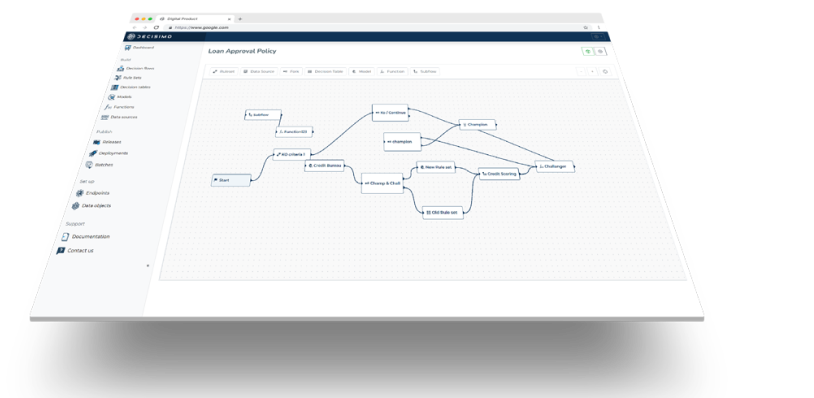
For the no-hit cases, assess what the second source adds: its hit rate, which good and bad applicants it flags, the price per call, the loss per bad loan, and the profit per good one. The data source waterfall tool compares buying one source, both sources, or the second source only after a no-hit. Decisimo’s data-source documentation describes requesting information from REST APIs or SOAP web services in decision logic.
Before choosing a bureau and putting your policy into use, work through the decision in this order:
- List DataCrédito, TransUnion and Procrédito, and ask each which lenders and businesses contribute to its files.
- Rewrite any rule that declines on negative bureau data alone, so the decision weighs it with other factors already defined in your application and credit policy.
- If you are a financial-system entity, keep objective reasons for each rejection so you can provide them in writing when an applicant asks.
- Interpret a file with no currently retained negative entry within the reporting time limits, and define what other evidence your policy accepts for thin files.
- Before reporting a debtor, send the required notice and wait 20 calendar days. For obligations at or below 15% of one monthly minimum wage, send at least two notices on different days and wait 20 calendar days after the last one.
- Keep evidence of authorisation where it is required, and report changes to the bureau at least monthly.
- Compare a second bureau using your own applicants, calling it only when the first source returns no hit. Assess the additional information, applicant outcomes and call cost before deciding whether to sign.
Questions about credit bureaus in Colombia
How many credit bureaus are there in Colombia?
Three commonly identified bureaus are DataCrédito, TransUnion and Procrédito. Ask each which contributors are relevant to your applicant segment.
What is the difference between DataCrédito and TransUnion?
DataCrédito is run by Experian, and TransUnion is the bureau formerly known as CIFIN. Compare each bureau’s contributors against your own applicant segment.
Is TransUnion the same as CIFIN?
TransUnion acquired CIFIN, and the bureau is commonly described as the former CIFIN.
Can I decline an applicant because of a negative credit report in Colombia?
No, not on negative bureau information alone. Weigh it with other factors in your application and credit policy, and, if you are a financial-system entity, provide objective reasons in writing when the applicant asks.
How long does negative information stay on a Colombian credit report?
It remains for twice the time in arrears, up to four years after payment or extinction, and all negative data expires eight years after the arrears began. Use those limits when interpreting a file with no currently retained negative entry.
What notice must I give before reporting a debtor?
Send notice before reporting negative information and wait 20 calendar days. For obligations at or below 15% of one monthly minimum wage, send at least two notices on different days and wait 20 calendar days after the last one.
Who regulates credit bureaus in Colombia?
The Superintendencia de Industria y Comercio supervises operators, sources and users. The Superintendencia Financiera does so for the entities it supervises, so identify which authority applies to your organisation and activity.
