Choosing a credit bureau in Nicaragua
In Nicaragua, TransUnion and SinRiesgos are the two authorised private credit bureaus, alongside the SIBOIF register of balances at supervised institutions. That register covers the latest available month, and SIBOIF itself directs users to the bureaus for credit history and information from casas comerciales. The distinction matters when you choose a source for credit decisions: the history you need sits with the bureaus, under written authorisation taken before each query and kept for audit. You must decide which bureau’s feeds fit your needs and how to treat debts retained after repayment.
SIBOIF register shows balances and bureaus show history
The SIBOIF register is an official source, and a current balance can matter when you assess an applicant’s obligations. But the SIBOIF’s own description sets a limit: its Central de Riesgo report, the “Detalle de Obligaciones Crediticias”, shows balances from the latest available month at institutions it supervises. For credit history and information from casas comerciales or other unsupervised entities, the SIBOIF refers people to private bureaus.
Use the register as a snapshot of current balances, and assess bureau history when your decision depends on credit history. The SIBOIF lists two authorised private credit bureaus: TransUnion de Nicaragua and SinRiesgos.
| Source | Run by | What it carries | Access |
|---|---|---|---|
| TransUnion de Nicaragua | TransUnion | Supervised lenders' data, and unsupervised lenders' where they report | Contract, written authorisation |
| SinRiesgos | Servicios de Información de Riesgos de Créditos, S.A. | Supervised lenders' data, and unsupervised lenders' where they report | Contract, written authorisation |
| Central de Riesgo | SIBOIF | Last month's balances at supervised institutions, no history | The person, in person |
The person named in the SIBOIF report requests it in person with their cédula.
Compare bureau contributors and applicant coverage
Compare TransUnion and SinRiesgos by the contributors behind their files and assess their coverage. Nicaragua’s private-bureau rules allow supervised banks and non-bank institutions to agree to supply information about active operations. The rules also allow bureaus to hold information from unsupervised entities.
For a microfinance institution, or IFIM, the CONAMI registration rule calls for a notarised copy of its agreement to supply positive and negative information to authorised private bureaus. The rule also requires IFIM portfolio reports to reconcile with bureau reporting.
Ask TransUnion and SinRiesgos which supervised lenders, microfinance institutions and retail lenders contribute information. Then check the files returned for the applicants you expect to serve. A list of contributors tells you who may be represented. Your applicant files tell you whether that representation reaches the population behind your launch.
Get written authorisation before bureau queries
Written authorisation is required before a bureau releases credit information. For an occasional user, the authorisation goes to the bureau with each query. A permanent user under contract keeps it on file, where the bureau’s audit firm may check it.
Ley 787 classifies credit and financial information as sensitive. Article 54 excludes information handled and regulated by CONAMI, the SIBOIF, supervised entities and private credit bureaus from the law’s scope, while the data owner’s rights and the law’s general limits still apply.
Apply retention and dispute rules
A repaid debt can remain on a bureau file for five years, counted from the earliest of the events specified in Article 12, including full repayment, a final judgment against the debtor, expiry of the right to enforce the debt, or prescription of the creditor’s action. That affects how you read an applicant’s history and how long information may inform a decision.
A dispute requires your response. An applicant can dispute an entry with the bureau or through you. The bureau forwards the dispute and marks the entry registro impugnado, or contested record. You then have ten business days to respond. When you miss that period, the bureau removes the entry temporarily.
| Step | The rule | Where |
|---|---|---|
| Before the query | The person's written authorisation, kept on file | Norma CD-SIBOIF-577 art. 8 |
| Records | 5 years from repayment or the other events of art. 12 | Art. 12 |
| A dispute | Your answer within 10 business days of the bureau forwarding it | Arts. 14, 15 |
| The person's report | Free once a year, within 5 business days | Art. 13 |
Test whether a second bureau adds value
Decide whether to use a second bureau by testing it on your own applicants and measuring the coverage it adds. The four options are A only, B only, B only when A has no hit, and both. For the third option, query the second bureau only for applicants with no file at the first. That lets you see which additional applicants the second source identifies and whether the extra information changes your decisions.
Keep the groups distinct in your analysis: applicants with a file at the first bureau, applicants with no file there but a file at the second, and applicants with no file at either. For the incremental files, compare the decisions they support and the outcomes as they mature. The data source waterfall tool compares source strategies using hit rates, the good and bad applicants each source flags, price per call, loss per bad loan and profit per good one.
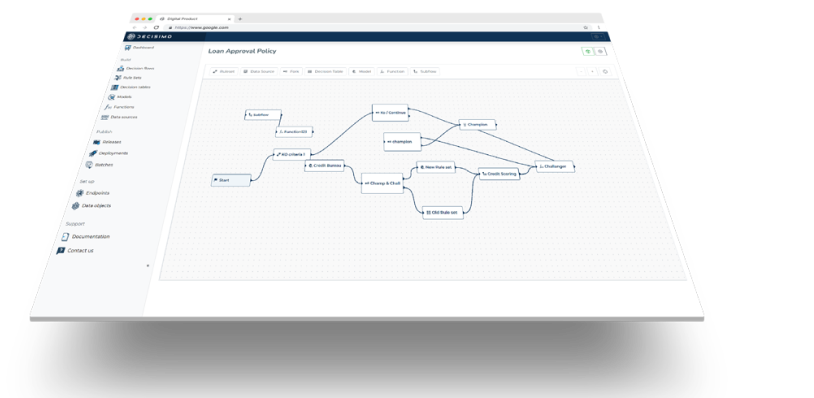
Decisimo’s data source documentation describes a connection to any REST API or SOAP web service. It also describes handling a failed call as a decision-flow branch, so the decision can respond to the error details. That is relevant when you plan a second call only after a no-file result from the first.
Put the source choice into operation:
- Use the SIBOIF Central de Riesgo report for the latest available month’s balances at supervised institutions. The person named in the report requests it in person. Take credit history from a bureau.
- Obtain written authorisation before every bureau query. Give it to the bureau each time for occasional use, or keep it on file for permanent use under contract.
- Ask each bureau which supervised, microfinance and retail lenders contribute to its files, then assess the returned files on your applicant population.
- Set your policy with the five-year retention period in view, counted from the applicable event in Article 12.
- Track disputes forwarded by a bureau and answer within ten business days.
- Query a second bureau only for applicants with no file at the first. Compare the additional files, their effect on decisions and outcomes, and the query cost before deciding whether to use the second source.
Questions about credit bureaus in Nicaragua
How many credit bureaus are there in Nicaragua?
There are two authorised private bureaus listed by the SIBOIF: TransUnion de Nicaragua and SinRiesgos.
What does the SIBOIF Central de Riesgo report show?
It shows balances from the latest available month at institutions supervised by the SIBOIF. It does not provide credit history or information from casas comerciales and other unsupervised entities.
Do I need the applicant’s authorisation to pull a report in Nicaragua?
Yes. Written authorisation is required before each query. An occasional user gives it to the bureau each time, and a permanent user keeps it on file for the bureau’s audit firm to check.
How long does a debt stay on a credit report in Nicaragua?
Five years, counted from the earliest applicable event in Article 12. Those events include full repayment, a final judgment, expiry of the right to enforce the debt, or prescription of the creditor’s action.
How does an applicant dispute a bureau entry?
The applicant can dispute it with the bureau or through you. The bureau forwards the dispute and marks the entry registro impugnado. You have ten business days from the forwarding to respond.
Can a bureau stop me from using the other bureau?
No. Article 8 allows you to use the other authorised bureau.
Can an applicant get their bureau report for free?
Yes. An applicant can get a report free once a year, within five business days.
Who receives a corrected report after a dispute?
The applicant and the users who received the disputed information are notified of the correction.
Does Nicaragua’s data protection law apply to credit data?
Credit and financial information is sensitive under Ley 787, but Article 54 excludes information handled and regulated by CONAMI, the SIBOIF, supervised entities and private credit bureaus from the law’s scope. The data owner’s rights and the law’s general limits still apply.
Do microfinance institutions report to the bureaus?
For IFIM registration, the CONAMI rule calls for a notarised copy of an agreement to supply positive and negative information to authorised private bureaus. It is also reported to require portfolio reports to reconcile with bureau reporting.
How does a person request a SIBOIF report?
The person named in the report requests it in person. They use their cédula.
