Credit bureaus in Venezuela: what to use instead
In Venezuela, the sole banking register is SICRI, which SUDEBAN maintains from banks' data for banks to query, while consumer lenders outside banking hold their own repayment records. The law bars SICRI's use for other purposes, and the search found no private bureau operating. A CEO of one of the largest consumer lenders says payment history remains, for now, within the ecosystem that generated it, with shared data still under construction. That leaves you to decide how much of your first exposure can rest on repayment evidence from your own book.
A bureau score depends on shared payment history
A contract with a credit bureau is a familiar part of a launch plan when you have opened products in other Latin American markets.
Bloomberg Línea reported that Cashea’s CEO said reported payment histories remain within the ecosystem where they were generated. It also reported that the largest consumer lenders outside the banks grade customers on their own repayment records.
No private bureau was found operating for lenders to query. Your first rule needs to start from information you can build in your own book.
SICRI access follows the purposes set by law
The SICRI is the Sistema de Información Central de Riesgos, a register of credit activity maintained by SUDEBAN, Venezuela’s banking regulator. Banks provide data to the register and query it. The law limits its use to the purposes it sets out.
The law says SICRI information may be supplied to the person concerned or their authorised representative. It also restricts banks from giving third parties information about a customer’s deposit and lending operations. A bank may share that information with the customer’s written authorisation, subject to specified legal exceptions.
| Step | The rule | Where |
|---|---|---|
| The SICRI | Only for the purposes of the law | LISB art. 88 |
| Who receives SICRI data | The person or their authorised representative | LISB art. 89 |
| A bank's data on a customer | Not to third parties without written authorisation | LISB arts. 86, 90 |
If you are a bank, apply the law’s purpose rules when you query the SICRI. If you are seeking an applicant’s bank information, obtain the applicant’s written authorisation first.
Your repayment book sets the first limit
Your own repayment history is the starting source for assessing customers. The SICRI holds credit activity reported by banks, and a person can obtain their own position through SICRI en línea.
| Source | Run by | What it carries | Who reads it |
|---|---|---|---|
| SICRI | SUDEBAN | Banks' credit activity: cards, direct and indirect credits, guarantees, write-offs | Banks, and the person their own |
| SICRI en línea | SUDEBAN | The person's own position, by email | The person |
| Your own book | You | Your customers' repayments | You |
Start each customer at a limit supported by the information available to you. Then raise limits as customers establish a repayment record.
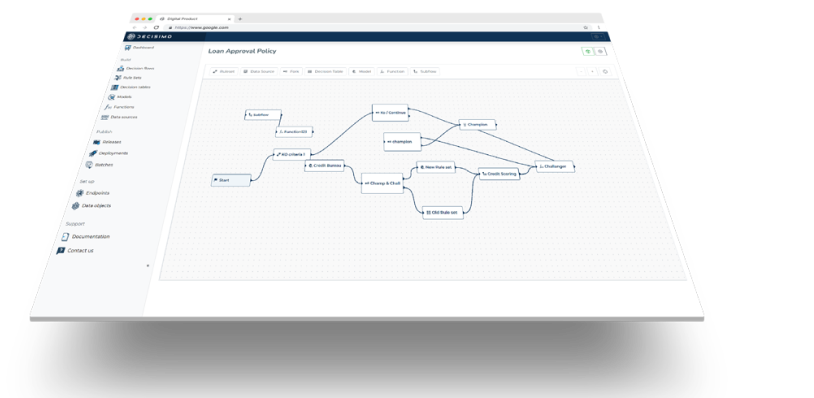
Compare a shared source with your repayment outcomes
A new source belongs in your decision only if its additional information improves the result enough to justify its cost. Replay past applications using the proposed source alongside your existing rule.
The data source waterfall tool compares four options: A only, B only, B only when A has no hit, and both, using hit rates, price per call, loss per bad loan and profit per good one. That comparison tells you whether the new source adds value to your book.
If the source passes that test, it can be called from decision logic. Decisimo’s data source documentation explains how a data source connects to any REST API or SOAP web service, and how a failed call routes to a fallback branch like any other data source error. Put the source into the rule only after testing its effect against your own repayment outcomes.
Build the first approval rule from your repayment book
Build a first approval rule around the history your book can produce. Do not include a bureau source until one is available and has shown value against your own outcomes.
- If you are a bank, query the SICRI only for purposes allowed by law.
- Request an applicant’s bank data only after obtaining the applicant’s written authorisation.
- Set each customer’s starting limit from what your own data supports, then raise it as repayments come in.
- Record each repayment in a form your rules can read.
- Test any shared source against your own repayment outcomes before putting it into a rule.
Questions about credit data in Venezuela
Is there a credit bureau in Venezuela?
A search found no private credit bureau operating in Venezuela. Bloomberg Línea reported that Cashea’s CEO said reported payment histories remain within the ecosystem where they were generated. It also reported that the largest consumer lenders outside the banks grade customers on their own repayment records.
What is the SICRI?
The SICRI is SUDEBAN’s register of credit activity.
Who can see SICRI data?
Banks query the register, and the law provides for information to be supplied to the affected person or their authorised representative.
Can a bank share an applicant’s data with me?
Only with the applicant’s written authorisation, subject to specified legal exceptions.
Can the SICRI include utility payments?
Yes. The law allows SUDEBAN to request public and private institutions’ records of timely public-service payments to support risk assessment and credit access for people without a banking history.
How do consumer lenders in Venezuela assess risk without a bureau?
They use their own customers’ repayment records.
What does a SICRI report show?
Since 21 February 2022, the emailed PDF has listed the person’s credit position, including cards, direct and indirect credits, guarantees and write-offs.
How does a person get their own SICRI report?
The form asks for the person’s cédula, an email address linked to a bank, a phone number and their state.
How large is bank lending in Venezuela?
At the end of September 2025, the bank loan portfolio was US$2,690 million, or 2.7% of estimated 2025 GDP, compared with about 22% a decade earlier.
