Choosing a credit bureau in the Dominican Republic
The Dominican Republic’s credit reports are held by four licensed Sociedades de Información Crediticia, or SICs, under one law. Before a report is pulled, written authorisation must state its purpose, and the record must be kept for six months. Using a report for a different purpose carries a heavier sanction than pulling it without consent, while its photograph must be matched to the applicant. Those rules leave you to decide which bureau’s report can support the permitted use and identity check.
Match each bureau report to its intended use
A separate decision is whether a report collected for a loan can later be used for a marketing campaign. List each decision your team expects the report to support.
For a loan application, draft the authorisation around assessing that application. If you also plan to use the information for marketing, name that intended use too. The report can be used only for the purpose stated in its authorisation, and the applicant’s identity must be checked against the report photo before you lend.
| Step | The duty | Where |
|---|---|---|
| Before the report | Express written consent stating the use, kept 6 months | Ley 172-13 arts. 5.4, 51 |
| Identity | Compare the applicant with the photo in the report | Art. 60 |
| The use | Only the use stated in the authorisation | Art. 86 |
| Old records | Defaulted credit shown up to 48 months from the last payment | Art. 64 |
| Report contents | No account balances, health, religion or politics | Art. 66 |
Before requesting a report, verify the applicant’s identity. The Junta Central Electoral issues the cédula and, under a service agreement, sells online cédula queries and biometric identity validation, as reported in 2020. After the report arrives, compare the applicant with its photo.
Consent wording and the identity check are part of choosing a bureau. A bureau can tell you what its source returns. The authorisation and operating rules determine how your team can use the report.
Consent rules make report misuse costly
Ley 172-13 regulates credit information companies, known as Sociedades de Información Crediticia (SICs). It requires express written authorisation before you request a report and says the authorisation must state how you will use the information. Keep the signed authorisation for six months.
Under Ley 126-02 art. 31, a digital signature has the force of a handwritten signature if it is unique, verifiable, under the signer’s sole control and linked to the document.
The law also recognises consent arising from a credit relationship and permits periodic consultations during that relationship. Credit-score reports are an exception to the authorisation requirement. For a product launch, write down the uses you intend to make of the report and collect authorisation before the pull.
The distinction matters to the book. A consultation without prior authorisation carries a maximum fine of 50 minimum salaries. Using the report for a purpose beyond the authorisation carries a maximum of 100.
| Violation | Maximum fine |
|---|---|
| Consulting without prior authorisation | 50 minimum salaries |
| Using the report for another purpose | 100 minimum salaries |
Compare licensed credit sources in the Dominican Republic
The Superintendencia de Bancos (SB) supervises SICs, and its register lists four licensed sources. The same consent and identity duties apply whichever SIC supplies the report.
| Source | Run by | Status |
|---|---|---|
| TransUnion | TransUnion | Licensed SIC |
| Equifax Dom (Data-Crédito) | Equifax, since March 2022 | Licensed SIC |
| Acierta | Acierta | Licensed SIC |
| Kalifika | Kalifika | Licensed SIC |
| Central de Riesgos | Superintendencia de Bancos | The supervisor's register, for EIFs |
Equifax acquired Data-Crédito in March 2022. For an entidad de intermediación financiera (EIF), the SB’s Central de Riesgos is another option, a register of portfolios, debtors and guarantees reported by financial intermediation entities.
Apply report limits in credit policy
Set your policy to account for the period a default can remain visible. A defaulted revolving credit record may remain for up to 48 months from the last payment. An instalment credit record may remain for up to 48 months. When a historical record appears, assess it against the date of last payment and the rules you have set for that product.
Use the information SIC reports may lawfully contain. Account balances and movements, certificates of deposit, health and religion are outside the permitted report contents. Keep those items out of the inputs to your bureau-based credit rules, and do not interpret their absence as a zero balance or as a positive credit signal.
An applicant can obtain a free SIC report four times a year. While a claim over a disputed record is pending, the record carries the label “Registro Impugnado por Hábeas Data”. A paid-off loan marked “Legal” or “Incobrable” remains for up to 12 months.
A SIC must provide access to a person’s information within 5 business days. It must correct disputed data within 10 business days and flag the data as disputed while the correction is pending.
Test a second SIC with your applicants
Compare a second SIC on your applicants before you sign. For the same applicant cohort, record each source’s hit or no-hit, which applicants it flags, the cost of each call and the resulting loan outcomes. Then compare the added value from applicants found or correctly identified by the second source with the price per call, the loss per bad loan and the profit per good one.
Run more than one calling strategy: the first source alone, the second alone, both sources, and the second source only when the first returns no hit. The no-hit option can reduce calls, but it can also miss applicants the second source would have flagged when the first returned a record. Choose against your own results, not the wording of a proposal.
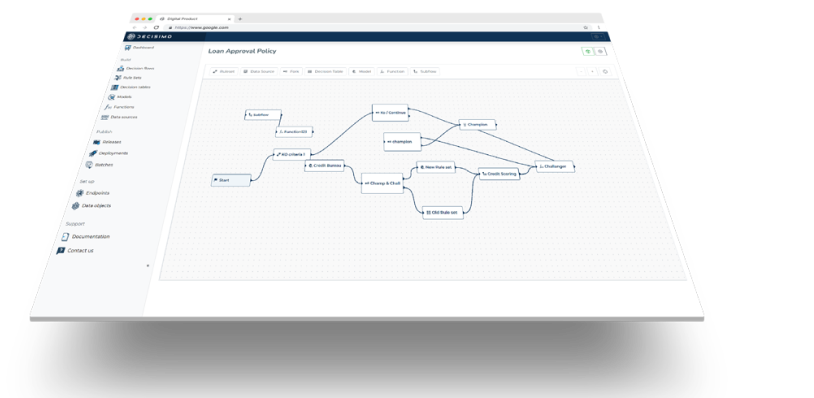
The data source waterfall tool compares source strategies using hit rates, flagged good and bad applicants, call prices, losses and profit. Decisimo’s data source documentation describes connecting any REST API or SOAP web service to decision logic. A failed call routes to a fallback branch like any other data source error.
Set consent and source checks before launch
Before launch, confirm that the authorisation states each intended use, and that your bureau comparison shows what each source adds to decisions on your own applicants.
- List the four SICs on the SB register. EIFs can include the Central de Riesgos among the sources to consider.
- Write each intended report use into the authorisation. Obtain it in writing or by digital signature, and keep it for six months from signature.
- Use each report only for the purpose stated in its authorisation.
- Compare the applicant’s identity with the photo in the report.
- Set credit rules with the up-to-48-month visibility period for defaulted revolving credit and the up-to-48-month period for instalment credit in mind. Use the last payment date to assess a reported revolving default.
- Keep account balances, health and religion out of bureau-based policy inputs, since SIC reports do not carry those details.
- Before signing a second SIC, compare it with the first on your own applicants. Test the no-hit strategy alongside other calling options, then choose based on added value and call cost.
Questions about credit bureaus in the Dominican Republic
How many credit bureaus are there in the Dominican Republic?
Four licensed SICs are listed on the SB register: TransUnion, Equifax Dom, Acierta and Kalifika.
Who owns DataCrédito?
Equifax acquired Data-Crédito in March 2022.
Do I need written consent to pull a credit report?
Yes. Ley 172-13 requires express written authorisation before requesting a report, with exceptions for consent arising from a qualifying credit relationship and for credit-score reports.
How long does consent to check credit last?
Consent is valid for two years or for the life of the credit relationship. Keep the authorisation for six months from signature.
How long does a default stay on a Dominican credit report?
A defaulted revolving credit record may remain for up to 48 months from the last payment, and an instalment credit record may remain for up to 48 months.
Can consent to a credit check be given by digital signature?
Yes. Under Ley 126-02 art. 31, a digital signature has the force of a handwritten signature if it is unique, verifiable, under the signer’s sole control and linked to the document.
What can a Dominican credit report not contain?
A SIC report cannot contain account balances or movements, certificates of deposit, or information about health, religion or politics.
How do I verify an applicant's identity against a credit report?
Compare the applicant with the photo in the report. The Junta Central Electoral issues the cédula and, under a service agreement, sells online cédula queries and biometric identity validation, as reported in 2020.
What is the Central de Riesgos?
It is the SB’s register of portfolios, debtors and guarantees reported by financial intermediation entities. EIFs and data subjects can consult it.
