Choosing a credit bureau in Argentina
Argentina separates the public debt register from private bureau reporting: the BCRA holds the Central de Deudores, while firms such as Veraz and Nosis provide private bureau files. The public register is available to every lender through a free API without authentication, with a CUIT or CUIL lookup, the latest situation, 24 months of reporting history and bounced cheques. A paid debt must leave a bureau file after two years. You have to decide whether a private report adds enough beyond that register to justify its contract.
BCRA data is the first credit check
Signing with a familiar private bureau first may seem like the natural way to begin credit checks in a new market. You may also expect the central bank’s information to be available only to banks. The BCRA’s Central de Deudores del Sistema Financiero, or CENDEU, changes that starting point.
The BCRA publishes a free API that anyone can query without authentication, using an applicant’s CUIT or CUIL. The register covers information reported by financial entities and other participants, including non-bank credit providers registered with the BCRA, known as PNFC. Its returns include the latest situation, the last 24 months of history and bounced cheques.
A monthly full-database file is also available through the BCRA’s secure site to financial entities, PNFC, SGRs and P2P platforms. Access is subject to a sworn statement on data protection duties.
You can start each applicant’s credit check with the BCRA’s Central de Deudores. A paid report has to add something your decision needs.
Compare paid reports with your decision needs
Compare each private report with the BCRA information against the needs of your own credit decision. Veraz is administered by Equifax and includes a report and Score Veraz, which is reported as drawing on BCRA, court and entity data. Nosis is another established credit information provider. Ask each provider which records and scores its report covers, and how those items are returned.
When you pull Veraz, the applicant may also receive an email through Equifax’s free Alertas Veraz service. Since November 2025, the service has reportedly emailed people when someone queries or changes their report.
| Source | Run by | What you get | Price |
|---|---|---|---|
| Central de Deudores | BCRA | Latest situation, 24 months of history, bounced cheques, by CUIT or CUIL | Free, public API |
| Veraz | Equifax | Report and Score Veraz (1 to 999) | Contract |
| Nosis | Nosis | Credit information | Contract |
| Fidelitas | Not found | Credit information | Contract |
For each item your policy uses, confirm whether the BCRA, Veraz, Nosis or another provider supplies it. Then test whether the item changes approvals, declines or expected losses on your applicants. A provider’s name or score alone does not show the value it adds to your book.
Check age and payment status of negative data
Ley 25.326 art. 26 and Decreto 1558/2001 allow solvency data to remain for five years from the last adverse information showing that a debt was due. Once the debt is paid or extinguished, the period is two years from that date. Positive data with no arrears has no deletion deadline.
When an old entry changes a decision, check when the adverse information was recorded and whether the debt was paid or extinguished. That check matters to the applicant, and it matters to the quality of the decision: stale negative information can turn into an avoidable decline. Res. 126/2024 classifies keeping solvency data beyond the permitted period as a serious infraction.
Set notices and explanations for credit decisions
When negative data leads to a covered credit decline, the consumer must be told immediately and free of charge about the result of the query and the source of the information. This rule applies to financial entities and to other entities where the BCRA so provides. If you are a PNFC, establish whether it applies to your operation.
On request, a bureau must disclose to a person the evaluations it communicated about them during the previous six months.
When you rely on consent, you must be able to prove that the person who gave it is the data subject.
A separate rule gives a person the right to ask for an explanation when a decision based only on automated processing significantly affects them negatively. Preserve the logic applied to that decision so your team can explain it on request. The response from a bureau and the final outcome alone cannot tell you how the decision was reached.
| Step | The duty | Where |
|---|---|---|
| The data | Solvency and credit data only | Ley 25.326 art. 26.1 |
| Records | 5 years from the last adverse entry, 2 years after payment | Art. 26.4, Decreto 1558/2001 |
| A decline on negative data | Tell the consumer at once, free, with the source | CCyC art. 1387 |
| An automated decision | Explain the logic on request | AAIP Res. 4/2019 |
Test paid reports on your applicants
Run the BCRA alone against your applicants, then compare the decisions with a paid call made when the free register leaves a question open. The useful result is what changes: which bad applicants the extra information identifies, which good applicants it would also flag, and how those changes affect the loss per bad loan and profit per good one.
Include the cost of each call in that comparison. The data source waterfall tool compares options such as calling a paid source only when the first source has no hit, weighing flagged good and bad applicants, price per call, loss per bad loan and profit per good one.
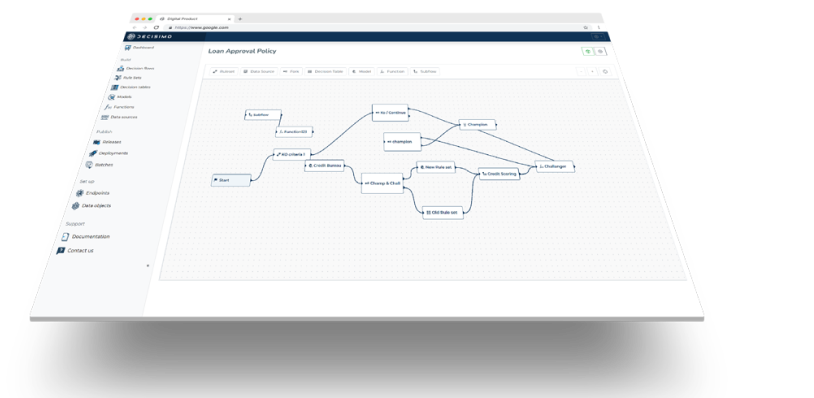
A decision flow can call more than one data source. Keep a failed call distinct from a response, so your rules can handle an error separately from information returned by the provider. Decisimo’s data source documentation explains how a data source can connect to any REST API or SOAP web service and how a failed call can be handled in the decision flow.
Before deciding whether Veraz or Nosis adds value, use this sequence on your own applicants:
- Query the BCRA’s Central de Deudores for each applicant by CUIT or CUIL. Read the latest situation, the 24 months of history and the bounced cheques.
- List what your decision still needs, then ask Veraz, Nosis and any other provider which of those items its report covers.
- When an entry concerns a paid or extinguished debt, apply the two-year period from the date of payment or extinguishment. For other solvency data, account for the five-year period from the last adverse information showing that the debt was due.
- When negative data leads to a decline covered by the rule, tell the applicant immediately and free of charge about the query result and name the source.
- Preserve the logic applied to each significant negative automated decision so you can explain it on request.
- Compare the BCRA alone with a paid call on your own applicants. Make the paid call when the free register leaves the decision’s question open, and assess the decisions against the price per call, loss per bad loan and profit per good one.
Questions about credit bureaus in Argentina
How many credit bureaus are there in Argentina?
Veraz, Nosis and Fidelitas are private credit information providers known in the Argentine market, alongside the BCRA’s Central de Deudores.
What is the BCRA Central de Deudores?
It is the BCRA’s register of credit information reported by financial entities and other covered participants, including registered PNFC.
Is the BCRA Central de Deudores API free?
Yes. The public API is free and requires no authentication.
Who runs Veraz?
Equifax administers the Veraz database.
Can an applicant see who checked their credit report?
Alertas Veraz has reportedly emailed people when someone queries or changes their report since November 2025. On request, a bureau must disclose evaluations it communicated about the person during the previous six months.
What data may an Argentine credit bureau hold?
An Argentine bureau may hold patrimonial data on solvency and credit from public sources, from the person, or with consent, as well as payment and default data from creditors. Positive data with no arrears has no deletion deadline.
How long does a debt stay on an Argentine credit report?
Solvency data may generally remain for five years from the last adverse information showing the debt was due, and for two years from the date it is paid or extinguished.
What must I tell an applicant I decline because of a negative report?
The rule binds financial entities and other entities where the BCRA so provides. They must tell the consumer immediately and free of charge about the query result and the source of the information.
Can someone ask for an explanation of an automated credit decision?
Yes. A person may ask for an explanation when a decision based only on automated processing significantly affects them negatively.
