Resources

Lending

Credit underwriting, scorecards, lending policy and BNPL decisions

Typical Underwriting Policy in Consumer Lending and Buy Now, Pay Later

Underwriting policy in consumer lending and BNPL looks tidy on paper, but in practice it is built from losses, fraud cases, regulatory pressure, and collections outcomes. This article breaks down the core components: age and eligibility gates, identity and blacklist checks, credit risk and affordability logic, and how those parts become operational decision logic.
8 min read

The Typical Org Chart of a Consumer Lending Company

This article maps the typical org chart of a consumer lending company. It explains who owns sales, product and marketing, underwriting, collections, risk, operations, and IT. You will see how these teams apply decision logic across acquisition, servicing, and compliance.

7 min read

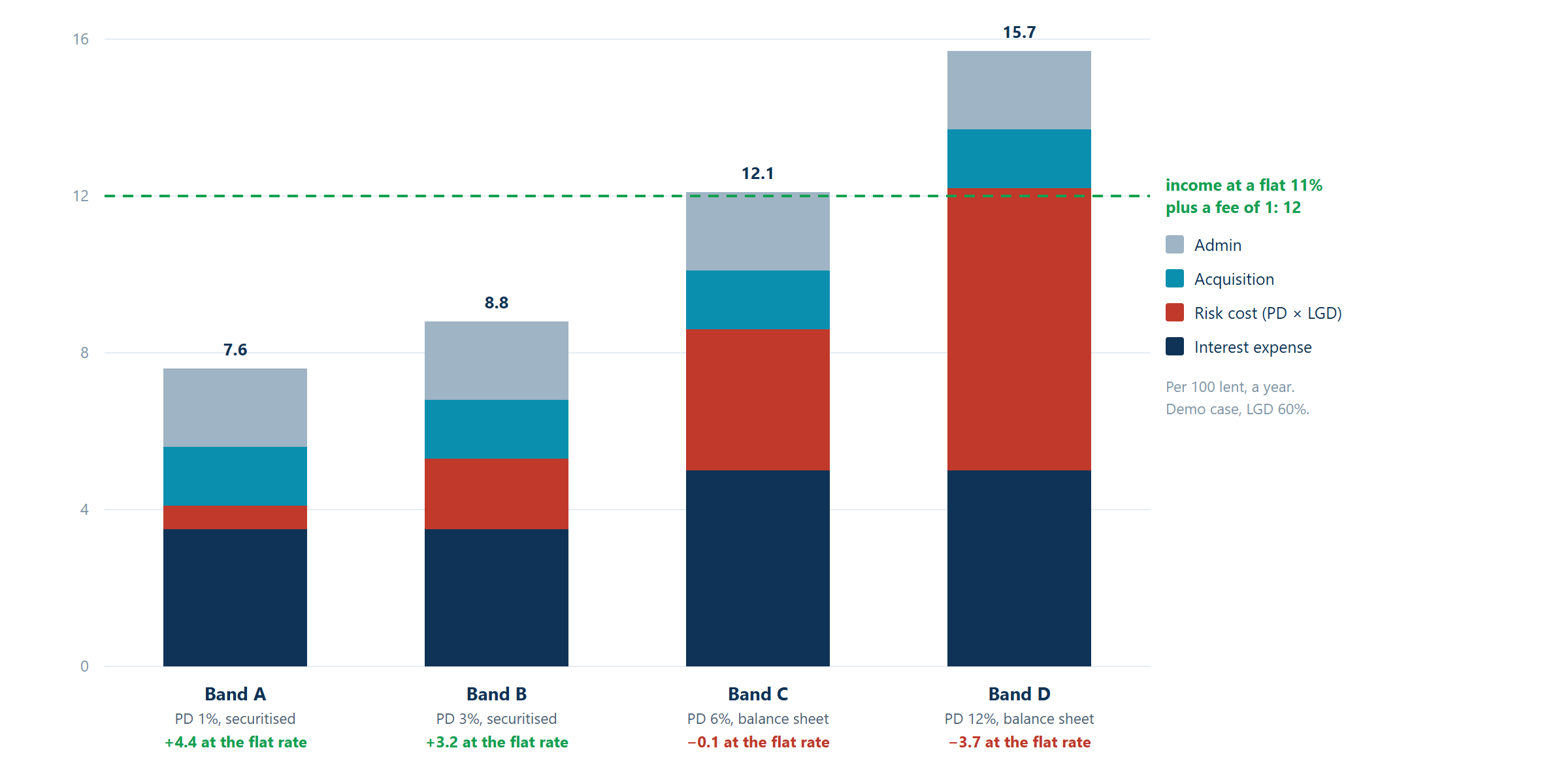
Risk-Based Pricing: Why Lenders Do It and How the Rate Is Built

One rate can lose your strongest applicants to a competitor that prices by risk, and you are left with the customers it priced higher or turned down. Set each customer’s rate from the funding, risk, acquisition, and other costs that customer brings to your book.

5 min read

How to set up the process for credit approval

This article explains how to set up an 8-step credit approval process, from application to funding, and where each step should support automated, auditable decision logic. It covers verification, credit checks, underwriting, approval outcomes, documentation, and funding, and it notes that the steps vary by loan purpose.

6 min read

What data analytics areas need to be covered in the lending business

Lending decisions rely on more than credit checks. This article explains the data analytics areas lending teams need to cover, from marketing and sales to risk, fraud, portfolio management, and process improvement, and shows how each area supports better decision logic.

7 min read

Credit risk strategy in micro-lending

Micro-lenders face specific credit risks that demand a focused, operational strategy to cut default probability and improve repayment. This article defines four core risk groups (business, country, sector, borrower) and lays out practical controls: structured credit analysis, personal guarantees and collateral, LTV and term limits, risk-based pricing, portfolio reviews, provisioning, collections, and selective use of alternative data. It also shows how to encode these policies as auditable decision logic.

4 min read

Credit limit management for BNPL / Consumer lending

Credit limit management in BNPL and consumer lending is not a one-time check. It starts at underwriting, continues through upsell and cross-sell decisions, and should also run during portfolio monitoring as customer behavior changes. This article covers the main factors behind limit setting, when to increase limits, and when to reduce them.

3 min read

Setting up eligibility rules in credit lending

Eligibility rules are the first layer in any credit decision flow, whether you offer consumer loans or BNPL. This article explains how to set a clear baseline, from regulatory checks like age and debt-to-income ratio to business-specific criteria such as employment history, credit score, and prior lending history with you. It also shows why these rules should be designed with later fraud monitoring in mind.

2 min read

Consumer Lending Hub | Decisimo

Consumer lending depends on decisions. This hub covers the main decision areas in lending, from anti-fraud and underwriting to credit limits, portfolio management, analytics, and debt recovery. It also shows how a decision engine can automate each part of the process.

1 min read

Alternative data for credit scoring

Fintechs adopted alternative data for credit scoring first. Banks are now catching up. This article explains how alternative data can act as a proxy for credit history, and where that proxy fails: spurious correlations, seasonal effects, and weak causality. It also covers legal and discrimination risks, and the engineering work needed to turn unstructured signals into reliable AI and ML decision logic.

4 min read

Creating Documentation for Credit Scoring Model

Clear documentation separates a usable credit scoring model from one that is difficult to defend. This article covers what to include, from management goals and sample selection to the sampling methods used in training, validation, and out-of-time testing.

5 min read