Claims rules engines for routing claims and reopening reviews
Your claims operation is looking at a storm claim that has been with an adjuster for a week, and the file is close to agreement on the amount. That morning, an investigation on a separate claim confirms fraud. One party on that claim is also named in the storm loss now in front of your adjuster. The handler has not been told. You can see how the two files touch, but the adjuster is working from the claim already in hand, with the amount about to be agreed. Where does that connection enter the work?
What claims rules engines decide
A claims rules engine checks a claim against its policy, scores fraud indicators and chooses a route. At first notice of loss, it can check whether the policy was in force on the loss date, whether the peril is covered and what deductible applies. It can score indicators such as an early loss, late reporting or a party linked to a confirmed fraud claim. Those indicators can send a claim to the special investigations unit for review, but they do not prove fraud on their own.
The engine can route a claim to fast track, an adjuster, special investigations or a decline. Small, clean, covered claims may be settled automatically. Other claims stay open while an adjuster gathers evidence or an investigation reaches a finding. A decision flow answers one call. Case work keeps the claim open as information arrives and people make decisions.
One routing rule set uses investigation findings
One routing rule set decides the route at first notice and after an investigation. Across six claim scenarios, the Property claim review example reads coverage, the indicator score, the claimed amount and the investigator’s finding.
| Claim | Coverage | Indicator score | Claimed | Investigation finding | Route |
|---|---|---|---|---|---|
| Burst pipe, clean | covered | 0 | 2,400 | none | fast track |
| Storm roof, clean | covered | 0 | 18,000 | none | adjuster |
| Fire 12 days after inception, party on a fraud claim | covered | 5 | 18,000 | none | SIU |
| The same claim after investigation | covered | 5 | 18,000 | no fraud | adjuster |
| The same claim after investigation | covered | 5 | 18,000 | fraud confirmed | decline |
| Excluded peril | not covered | 0 | 900 | none | decline |
A clean burst pipe goes to fast track, a larger clean storm loss goes to an adjuster, and a fire claim with a party linked to confirmed fraud goes to special investigations. For that same fire claim, a finding of no fraud sends it to an adjuster, while a finding of fraud confirmed sends it to a decline. An excluded peril is also declined.
The case design gives Routing a task that reads those values, including the investigation finding, and writes the route.

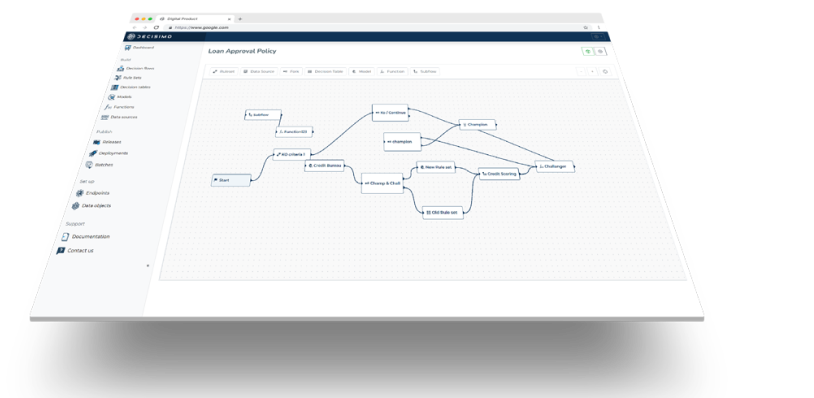
The Flow records the dependency as Routing reading the finding produced by Special investigation.

The example was built in Decisimo’s test environment, and its rule sets were tested on the claims shown here.
Changed claim inputs reopen affected work
A claim that stays open needs case work because information and decisions arrive over time. A task runs when its conditions are met. When a value the task reads changes, the task runs again.
For the storm claim, the new connection enters through the input that counts parties on the claim who appear on a confirmed fraud claim. Fraud indicators are scored again, and Routing reads the resulting score again. The Impact view identifies the tasks affected when that input changes.

In this example, four automated tasks run again and two human tasks reopen:
- Fraud indicators
- Routing
- Automatic settlement
- Claim memo
- Special investigation, a human task
- Adjuster review, a human task
The adjuster’s review returns as a fresh task.
Assign rules and reviews to claim work
Keep coverage, fraud indicators, routing and human decisions distinct. Coverage checks whether the policy is in force and the peril is covered. Fraud indicators score the information available at first notice, including an early loss, late reporting, repeat claims and links to confirmed fraud. Routing reads those results, the claimed amount and the investigator’s finding.
Automatic settlement should handle routes that need no person. In the example, it pays a fast-track claim after the deductible and handles declines. The special investigations and adjuster decisions belong in human tasks, each with an assignee role, a deadline and the values needed for review. Those tasks make the finding and the adjuster’s decision available to other work that depends on them.
The example routes a covered claim to special investigations when its indicator score reaches three or more. That threshold belongs to this example. Set the threshold for your own operation.
Check changing inputs before release
For the storm claim close to agreement, a new party link or a revised amount can change what work needs to happen next. Check each input that may change after first notice. In the example, both the linked-party input and the claimed amount bring back the same four automated tasks and two human tasks.
- List the decisions the claim needs and who makes each one: coverage, fraud indicators, route, settlement, investigation finding and adjuster decision.
- Put coverage and fraud indicators in separate tasks, each using a rule set on the first-notice information.
- Write one routing rule set that reads coverage, the indicator score, the claimed amount and the investigator’s finding, so the same rules route the claim again after an investigation.
- Use automatic settlement only for routes that need no person: fast track and decline.
- Give special investigations and adjuster review separate human tasks with an assigned role, a deadline and the values needed for review.
- Before release, use Impact on every input that may change after first notice, including a party linked to confirmed fraud elsewhere and a revised amount. Confirm which tasks run again and which human reviews reopen.
Questions about claims rules engines
What is a claims rules engine?
A claims rules engine checks a claim against the policy, scores fraud indicators and routes the claim. A decision flow answers one call, while case work keeps a claim open as information and human decisions arrive. Decide which claim decisions belong in rules and which need a person.
Which claims can be paid automatically?
Small, clean, covered claims can be paid automatically after the deductible. In the example, the automatic settlement task pays the burst pipe claim and handles declines. Set the fast-track criteria for your own operation.
What fraud indicators should be checked at first notice of loss?
Common indicators include an early claim, late reporting, several claims involving the same policy or person, and a party, address, phone, vehicle or repairer linked to an earlier claim confirmed as fraud. These indicators do not prove fraud on their own. Use them to decide whether the claim needs investigation.
How do claims get routed to special investigations?
Routing rules can send a covered claim to special investigations when its fraud indicator score reaches the chosen threshold. In this example, a score of three or more sends the claim there. Choose and review a threshold for your own operation.
What happens to a claim after an investigation finds no fraud?
The same routing rules send the claim to an adjuster. In the example, that happens when the investigation finding changes to no fraud. Keep the finding as an input to routing so the claim is evaluated again.
What is the difference between a claims rules engine and a claims management system?
A claims rules engine evaluates coverage, fraud indicators and routing decisions. A claims management system handles the broader claim process, including work that continues after routing. Define the rules and the ongoing claim work as separate parts of the operation.
What fraud score should trigger a referral to special investigations?
Set the referral cutoff using your own claims and special investigations capacity, not a generic score. Replay the rules against claims with known investigation outcomes, then compare referral volume with how often an investigation changes the handling decision. Review results by peril, product and channel, and check missed fraud findings as well as unnecessary referrals. An indicator score prompts investigation, but it does not establish fraud.
How should we set the dollar cutoff for automatic settlement?
Set the cutoff within your delegated settlement authority, and vary it by claim type and complexity rather than using amount alone. Automatic settlement is best limited to covered claims with complete information and no unresolved investigation referral. Test claims just below and above the cutoff, including deductible and policy limit changes. Route exceptions to an adjuster when the exposure or evidence needs a person’s judgment.
How should we test claims routing before release?
Test each route at its decision boundaries, including scores just below and above the referral cutoff and amounts just below and above settlement limits. Include covered and excluded perils, no-fraud and fraud-confirmed findings, and claims whose inputs change after first notice. Confirm the expected route, which tasks run again and which human reviews reopen. Check for claims that match conflicting rules or fall through without a route.
