Turn a filed homeowners guideline into an insurance rules engine
You know the moment an agent reaches the end of a quote and calls underwriting to ask whether the home can be bound. Now you have the filed homeowners guideline open, its numbered sections ready to be put into a rules engine, and the work is to make those decisions available before the call. The first page gives you a clear place to begin. You read a condition, look at the fields the engine can use, and consider what the agent will see when a real application reaches that point. The document is written for the filing. The next step is yours.
The filed guideline gives you a policy to translate
A filed guideline gives you the policy to translate into decisions for agents. The real Maine homeowners filing used here is dated 2021, and its insurer is renamed Northfield Mutual. The 30 test homes described in this article are invented.
The four-page guideline has numbered sections for eligibility, referrals and catastrophe requirements. It also contains more measurable criteria than the other filings read. That makes it a strong place to begin when an agent calls to ask whether a home can be bound.
The document gives you a clear structure to read. Begin with each clause and identify the decision it asks you to make. Claims come after cover is bound, and the claims decision flow handles that part of the book.
Count which clauses can run on quote data
The filing is partly executable as written, and its clauses need different treatments. Of 91 new-business clauses, 27 are hard rules, 16 refer a risk, 19 allow it with a condition, eight need insurer-defined judgment criteria, and 21 need facts from outside a typical quote form.

Those classes separate decisions an engine can apply from decisions that need more information or an insurer’s criteria.

Sixty-two clauses state an outcome a machine can apply once it has the relevant fact. Only 35 run on typical quote-form data alone. Fifty-six clauses rely on facts gathered outside the form: 21 data clauses, 14 condition clauses, eight judgment clauses, seven referral clauses, and six hard-rule clauses. Eight need a number or definition from the insurer.
A referral can be an executable outcome because the engine can route the risk to underwriting. The underwriter’s decision after referral is a separate matter. The filing therefore supports a referral rule, with the underwriter deciding the risk after referral.
If a missing fact is treated as a pass, the engine can make a risk eligible when the guideline calls for a referral or a decline. That changes which risks reach the book under the filed policy. If every missing fact is treated as a failure, the engine can stop risks the filing would allow.
The tempting shortcut is to count entered rules as automated decisions. Count decisions the available facts can actually support.
Read each clause and table for its binding tests
Split each item into one decision on one fact, then read every table for the cells that can change the outcome. A clause joined by “or” can contain more than one check, and table cells may work together rather than as independent tests.
The loss-history table has nine cells. Three cells can fail an application on their own, and its same-peril footnote adds another binding test. Encoding all nine cells as independent checks would add rules that do no work. Missing one of the binding tests would make the engine less restrictive than the filing.
The unoccupied wording also needs a close reading. One clause makes a vacant home with no daily custodial care or an unoccupied risk ineligible. Another sets protective-device requirements for a dwelling unoccupied for three or more consecutive months of the year. The insurer must define “unoccupied,” because the answer can change the outcome for a seasonal home.
The roof wording leaves another interpretation open. It exempts tile, slate and similar “lifetime” roof materials. The insurer must identify which other materials qualify. A 31-year metal roof therefore requires the insurer to decide whether it qualifies.
These readings can change whether a risk is eligible or referred, so resolving them silently in the engine would turn interpretation into policy. Record the binding cells, conflicts and open wording for the insurer to decide.
Separate missing facts from missing underwriting criteria
A missing application fact calls for a data-source decision. A missing underwriting criterion calls for a decision from the insurer.
The filing’s furnace rule depends on furnace age, which a typical quote form does not ask for. The clause classification identifies furnace age as applicant-stated information. A practical choice is to add a furnace-age question to the quote form, so the rule has an input when the application is assessed.
Make the same source choice for each missing fact. Some may be stated by the applicant, some may come from inspection or insurer records, and some may require an address lookup. Adding a question makes the fact available from the applicant, but it also adds information the agent must collect. Choose the source and form change one fact at a time.
Judgment clauses need criteria before they can become rules. In this filing, the missing items include:
- Inspection: which risks require inspection, such as an age or value threshold.
- Attractive nuisance: a defined set of exposures and a size or height limit for each.
- Property condition: a condition scale for major systems and a passing standard.
- Unoccupied risk: the time a home can be empty, and how that definition relates to the separate three-month device requirement.
- Roof materials: which materials count as similar lifetime materials and the age limit for each.
Other judgment clauses need the insurer to define protection for ground-mounted solar panels, which unrepaired conditions count, and the hazard source and cutoff for landslide or mudslide exposure. The filing supplies none of those criteria.
Once the insurer supplies a definition or threshold, encode that agreed criterion as an executable check and retain the clause it implements. Until then, leave the judgment visible for an underwriter. The insurer’s agreed cutoff should determine when the clause runs.
Use rules for independent checks and tables for combinations
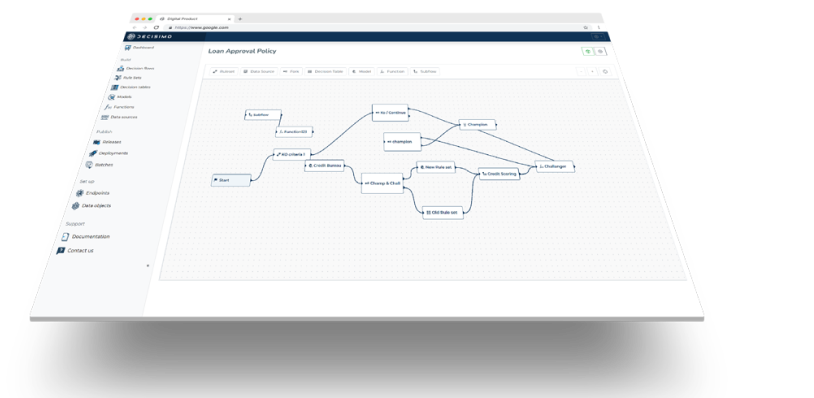
Build independent checks as rules in rule sets, and reserve decision tables for outcomes that depend on combinations of inputs. The implementation of this filing attaches the supporting clause to every rule and table row.
A roof-age check has its own outcome, so it belongs in a rule. Coastal requirements can depend on hurricane class, coverage amount, deductible, certification and flood insurance, so those combinations belong in decision tables.

The build takes each filed clause through classification and implementation, then produces four possible outcomes: decline, refer, condition or accept.
| Part | Kind | Checks | Outcome |
|---|---|---|---|
| Loss history knock-outs | rule set | 11 | decline |
| Property and exposure knock-outs | rule set | 27 | decline |
| Referrals | rule set | 15 | refer |
| Conditions | rule set | 4 | condition |
| Hurricane class requirements | decision table | 6 | decline, refer, condition |
| Value band and devices | decision table | 4 | refer, condition |
| Water back up limit | decision table | 7 | accept, condition, refer |
| Judgment findings | rule set | 6 | decline, refer |
The table above lists the build’s 80 rules and decision-table rows: 63 rules and 17 table rows. The other 17 rows cover combinations across three decision tables. Each part records a decision, reason and clause, and condition text where the outcome requires one.
The loss-history knock-outs are independent checks, so each has its own named rule and outcome.

That structure keeps the tests separate and makes the clause behind each result visible.
Value bands and protective devices depend on combinations of inputs. Keep those combinations together in a decision table, then use the decision table checker to check for gaps and overlaps.

The final decision flow combines the checks and selects the most severe result: decline, refer, condition or accept.

Keep each clause attached to its rule or row, and make the final outcome follow the severity of the results.
Test each decision against the filed guideline
Test the implementation against the guideline, then confirm that the decision flow runs. Compare each decision with the guideline reading, including the reason, the rule or row that fired, and any condition text.
The test included 30 invented homes, and the engine matched the guideline reading on all 30. Each test reached the same decision, reasons, rows fired and condition text. The runs were tests, with no release or deployment.

Some test applications were built to fail one binding loss-history test at a time. Crane tests the 12-month total, Mercer the 36-month non-weather count, Ellery the 60-month total, and Sewall the same-peril footnote. That isolates the individual tests before the full policy is assessed.
The Dalton house checks whether the engine identifies the rule behind a decline.

The Dalton house is declined because its roof is 27 years old. The result identifies reason code ROOF_AGE and clause C45.
The Pike house checks a different outcome. Every listed High 1 condition is met, but the filed guideline still directs a referral.

The result is a referral under clause C76. The engine applies the requirements and preserves the referral the filing specifies.
Test individual checks, then compare the decisions and reasons across the full application set with the guideline.
Give the agent the outcome and its filed clause
When the agent calls, the result should follow the guideline and show which clause decided it. The Dalton house is declined on its 27-year roof. The Pike house meets every listed coastal condition and is still referred because the filing directs a referral for every High 1 risk. The Harlow house is referred because it lacks the required alarm and because the filing leaves the treatment of an unoccupied seasonal home undefined.

These homes show the boundary between decisions the engine can apply and questions the insurer or underwriter must resolve. Use the same boundary when you put your own filing into service.
- Split the filing into atomic clauses, with one decision on one fact in each.
- Classify and count each clause, and mark the facts that need another source or a quote-form question.
- Read every table twice, identify the cells that bind, and record contradictions and open wording.
- List what each judgment clause lacks, and ask the insurer to supply the missing criteria.
- Choose which missing facts to add to the quote form and which to obtain from another source.
- Build independent checks as rules and combinations as decision tables, attach the filed clause to every rule and row, and let the most severe result decide.
- Test applications that each fail one thing, then compare every decision and reason with the guideline.
Questions about homeowners underwriting rules
What is an insurance rules engine?
It applies rules to application facts and returns an outcome and its reasons. In this homeowners example, the result also identifies the filed clause behind the decision.
How do you automate homeowners underwriting rules?
Split the filing into atomic clauses, classify them, identify missing facts and insurer-defined criteria, then build independent checks as rules and combinations as decision tables. Test each result against the guideline before release.
What does a homeowners underwriting guideline contain?
It can contain eligibility rules, referrals, conditions, tables and exceptions. This Maine filing also includes renewal provisions governed by state law. Other insurance lines have their own underwriting decisions, including life insurance and how life underwriting turns an application into terms.
Which underwriting rules cannot be automated?
A clause that depends on judgment the filing does not define cannot be decided from the filing alone. Ask the insurer for the missing criteria before turning it into a rule.
How do you test underwriting rules before they go live?
Run applications that exercise the rules, then compare each decision, reason and condition with the guideline. In this test, all 30 invented homes matched the guideline reading.
Why are some risks referred even when every rule passes?
Referral can be the filed outcome itself. The Pike house met every listed High 1 condition, but the guideline directs all High 1 risks to underwriting.
