The teams a BNPL launch needs
When launching buy now, pay later (BNPL), the most important team apart from technology is marketing. Risk comes next.
Within risk, underwriting is often fairly generic. There is only so much you can do. The most important part of BNPL is anti-fraud.
The wider BNPL team
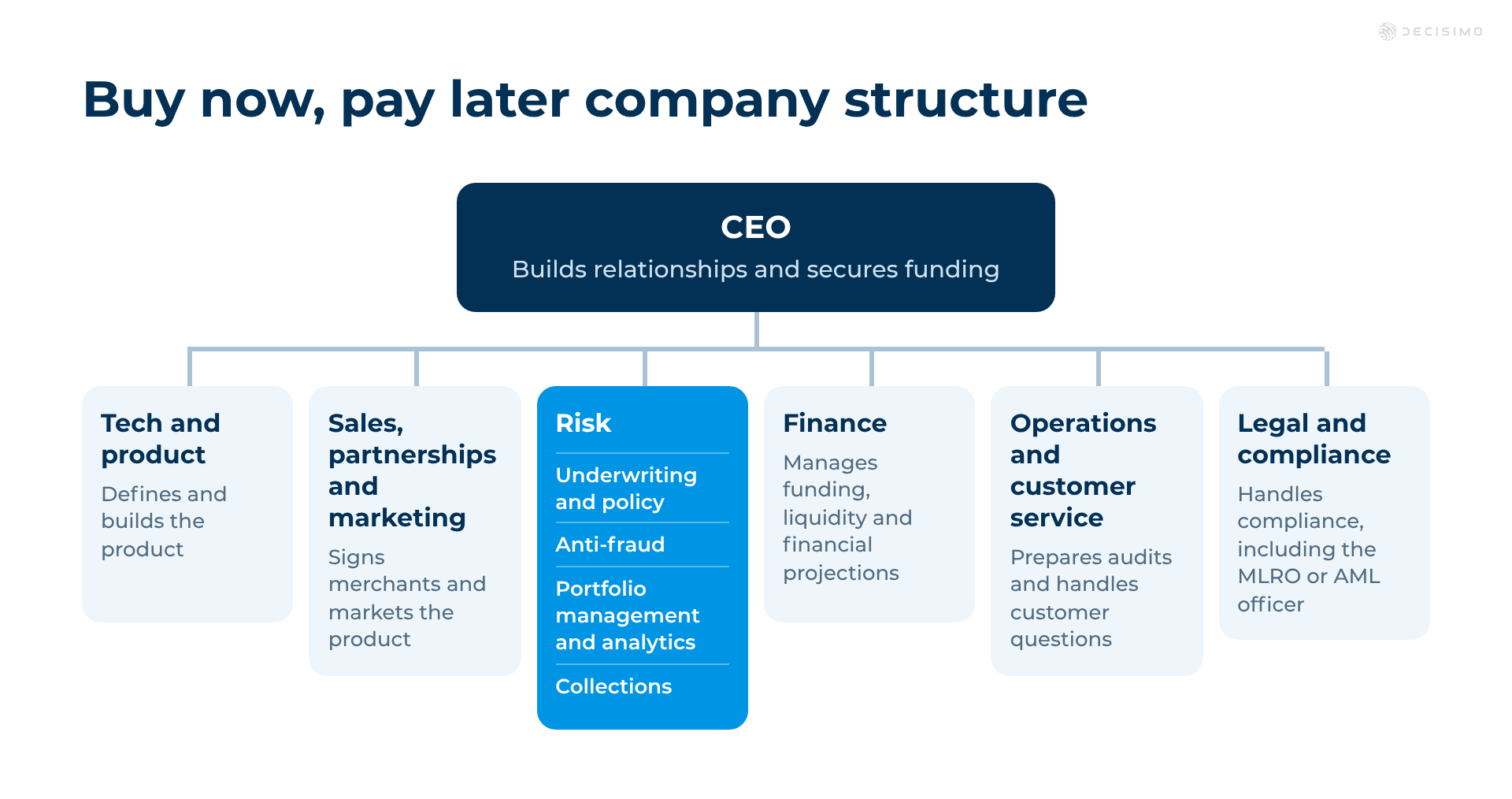
There is no single org chart for every buy now, pay later company. Small companies combine functions, and larger ones split them, but most follow the same basic structure.
Signing and growing merchants is often the responsibility of a separate sales or partnerships team. Marketing works on the customer side and with that team on how the product is presented at the merchant.
Customer service is a team of its own. It answers customers about payments, refunds and disputes, and handles complaints. Collections is often its own team or part of operations, with the collections strategy set together with risk.
Larger buy now, pay later providers have a capital markets or funding team in finance that raises warehouse lines and sells or securitises loans. In the UK, the person responsible for anti-money laundering is the money laundering reporting officer, or MLRO.
Marketing and merchant relationships
Marketing is a merchant-based job. It involves collaboration with the product team. Some people think it means launching campaigns on your own. The aim is to be at as many merchants as possible as soon as possible and to be in a good position. Often, customers do not care which buy now, pay later provider they use. They see that they can split the payment.
Effective marketing also involves being able to finance well. Good merchants that use the service and strong relationships with those merchants are important.
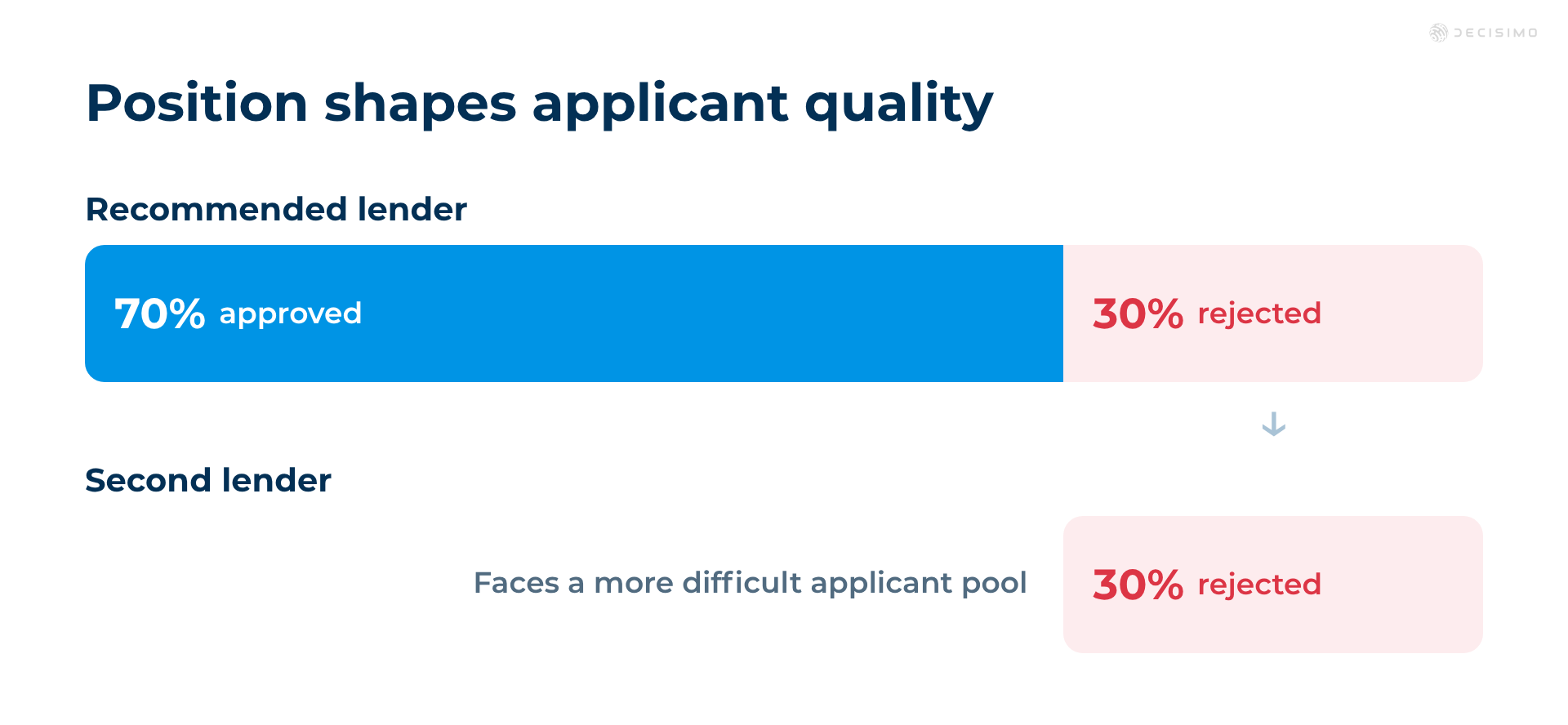
This positioning affects risk performance. If a lender is the first choice recommended to a user, it will get much better customers than the second choice. When the recommended lender rejects a customer, that customer goes to the second lender. The second lender therefore gets much worse customers.
Suppose the first lender has a 70% approval rate and reasonably good models. The second lender receives the 30% that were rejected, but still needs a high approval rate because of acquisition costs. It must have models with double or triple the separation quality. It may simply be done without that advantage. It may need another advantage. Creating those advantages through merchant relationships is part of the job of the marketing and product teams.
Risk, portfolio management and collections
Within risk, there is usually underwriting and policy. Anti-fraud is another important area.
Portfolio management and analytics look at who can be cross-sold or upsold, and what credit limits to set. When buy now, pay later is continuous, it behaves almost like a credit card.
Then there are collections.
Anti-fraud needs early monitoring
When you enter a market, fraudsters look at the new players. They know that anti-fraud resources are usually not well positioned, the policies are not set up, and the technology is not good enough at detection. That is why they start probing.
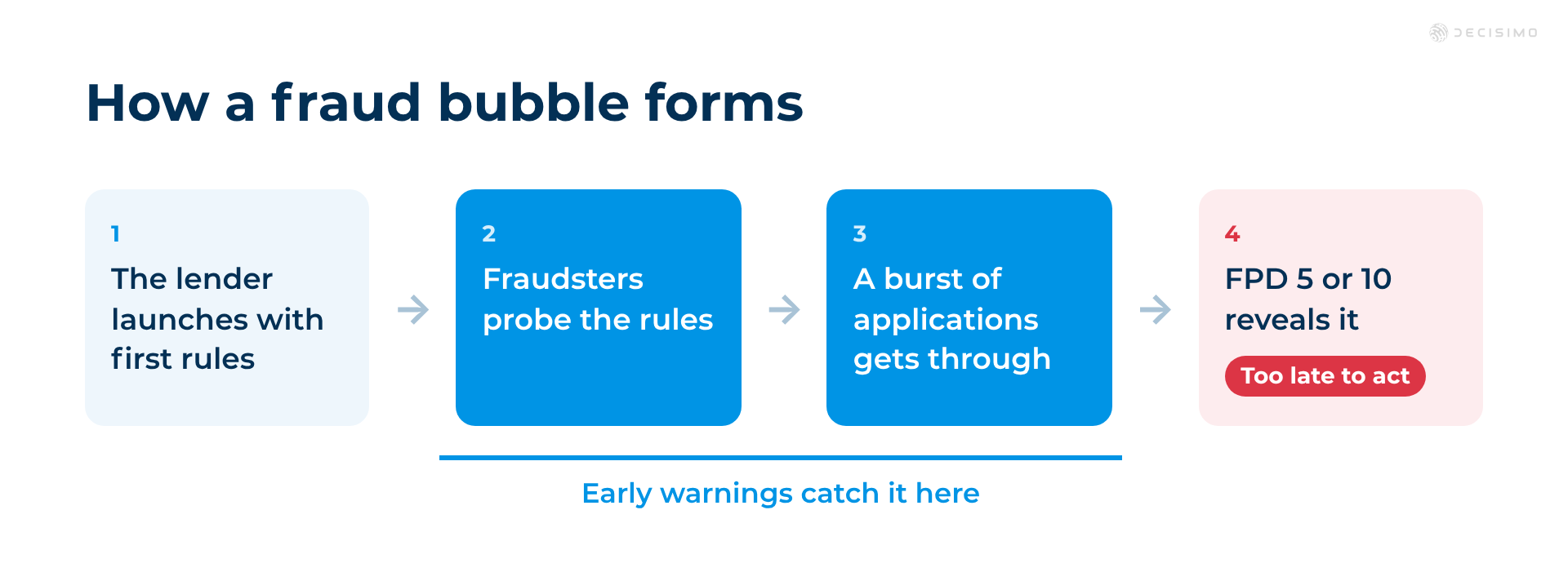
For a new lender, the biggest danger from the outset is receiving a fraud bubble. Fraudsters organize, figure out the initial rules, and attack with a large number of applications to get through. You discover that you have underwritten a fraud bubble only after the first payment default, or FPD, reaches 5 or 10 and you start looking at concentrations. By then, it is already too late. You know that you are done.
When setting up buy now, pay later, set up early warning signs at the application level. Start looking at concentrations and potential issues from the outset. There are also monitoring tools to use for BNPL. Fraud is often merchant-related, so look at merchants, merchant concentrations, and spikes. If you miss that, it kills you.
Connect multiple external data providers
From day one, watch for spikes in applications and concentrations in mobile phone numbers, locations, and device IDs.
When starting BNPL, connect to as many third-party data providers as possible. Set up the contracts so you can leave. Make the providers compete. Connect all of them instead of choosing one because somebody says company X or Y is good.
Once you have the first bads, analyze the results and disconnect whatever is not valuable. Quite often, most data services and anti-fraud services are not valuable. Some companies are big because many companies do not understand anti-fraud and have nothing in place. Sometimes something is better than nothing.
Once you connect multiple providers and analyze their results, you will often see that their scores have no correlation with identifying bad apples, bad credit, or fraud.
Bad loans provide essential data
When you book your initial portfolio, you will have bad loans. You need them because you cannot set up and update your rules without bad records and loans that will not pay. You cannot know who is bad and who is good.
If you are too strict about approval rates, you will not collect enough data to build models with the statistical significance and power needed to scale. Enter the market expecting some bad loans. They are very valuable.
Fraud is different. You do not want fraud.
Fraud monitoring
With fraud, look at velocity, concentrations, attribute volatility, and similarity. Do graph analysis of interconnected parties because fraudsters often reuse identities or parts of the synthetic identities they create.
They use data that is real or realistic, such as stolen identities. Then they connect it through synthetic identity markers, including a mobile phone number and an email address. Setting up an email address may be easy, but setting up a phone number can be more complicated.
Sometimes fraudsters create full synthetic identities and babysit them. There are also companies that provide babysat accounts, such as accounts that are two years old and have everything. A stolen identity with a good email address and mobile phone number can look completely interconnected.
These identities are rare and are not used for buy now, pay later very often. They are more common in high-volume or large-amount fraud because buying such a synthetic identity is expensive.
Fraud needs fingerprint checks
Warning signs include two applications using the same fingerprint ID. Use device fingerprinting or browser fingerprinting to find these links. Also look for applications suddenly coming from the same IP address, especially when the address belongs to a VPN or data centre.
Data services can help calculate a fraud score. MaxMind is often useful in payments and online BNPL.
Any online BNPL provider needs to treat itself almost like a payment provider. Manage the fraud risk in much the same way.
There is a saying that once you have entered the market, if you say you have not seen fraud, either you do not know that you had fraud or you are lying.
Finance and liquidity
Initially, financing teams are not that important as long as you secure enough lines to finance the product. The profitability of buy now, pay later is simple. You need a big enough kickback, or a path to profitability through cross-sells or other marketing resources.
Buy now, pay later products on their own are not quite profitable. Many companies realize this only after they have booked a large portfolio and do not know what to do with it. Finance needs to make sure that the money coming in and going out is covered, that lines are secured, and that the product is financed properly.
Finance also handles the P&L, projections, treasury, and liquidity. As the company gets bigger, liquidity management becomes more important. Seasonality and days off affect how much liquidity is needed. Paying merchants on time sustains the relationship. When merchants choose their first-priority provider, the speed of payment for purchased items can be an important factor.
Operations, legal and compliance
Then there is operations, which means having everything in order because it is a financial company. This includes the work related to audits, preparations and compliance.
Then there is legal and compliance. Initially, outsourcing this work may be cheaper. In some countries, an AML risk officer responsible for KYC may be required. That role may sit within compliance or sometimes within the risk team.
The risk team mainly focuses on risk analytics. That is very important at the beginning, especially for the fraud risks described above.
The CEO and regulatory relationships
The CEO’s main job in a financial company is to keep building relationships and looking for funding. That means constantly looking for equity funding, warehouse lines and credit lines. The CEO also needs to make sure the relationships for the warehouse lines are set up because they depend on trust. If the CEO is not spending at least 30% of their time on this, something is wrong.
The CEO also needs to spend time with regulators, and with any party or working group related to the regulatory side of buy now, pay later. BNPL is consumer lending, and consumer lending affects society.
Politicians often get involved in consumer lending during crises to protect consumers. The CEO needs to know what is happening in the market around consumer protection.
Questions about BNPL launch teams
Which teams need to be involved in a BNPL launch?
The structure usually includes product, merchant growth, risk, finance, operations, customer service, legal and compliance under the CEO. Sales or partnerships, collections, and capital markets or funding may sit in separate teams as the company grows.
Why does anti-fraud need attention from the start?
Fraudsters look at new players because their policies, resources and detection technology may not be ready. Early warnings should track application spikes, concentrations, merchants, mobile phone numbers, locations and device IDs.
How should a new BNPL provider approach external data services?
Connect to as many third-party data providers as possible and set up the contracts so providers can be replaced. Analyze their results after the first bad loans and disconnect services that do not provide value.
What does finance need to manage during a BNPL launch?
Finance needs to secure enough funding lines and cover the money coming in and going out. It also handles the P&L, projections, treasury and liquidity, including the extra liquidity needed for seasonality and days off.
