How a fraud rules engine handles checks and rules
The weekend’s cases are open on your screen as your fraud analyst confirms what links them: one device, several email addresses, and a ring moving through your checks. You want the next attempt from that device declined, and a velocity rule that can flag the next ring before it reaches the same point. The lending system team says neither change can be made before its next release. Then someone asks how many good customers from last month the rule would have stopped. You can discuss the cases in front of you, but that earlier set of decisions is not in the room.
Define the fraud decision before choosing signals
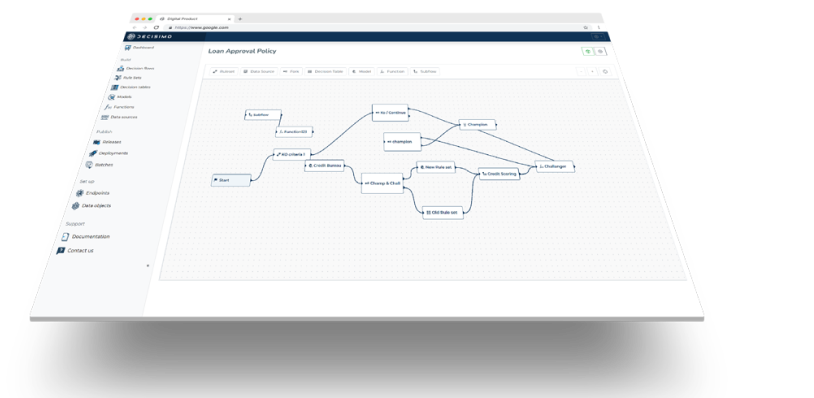
A fraud rules engine runs a decision flow each time it is called. The flow calls checks, evaluates rules and returns an outcome such as approve, review or decline. The fraud decisioning engine puts those parts into one decision flow.
For a BNPL checkout, each part has a distinct job:
- Data sources call checks such as device fingerprinting or an email check. A device fingerprint check supplies information the flow can use.
- Lists let the flow check whether a device or email is known, trusted or under investigation.
- A rule set evaluates conditions in order and applies the actions you define.
- A fraud score supplies one value the flow can use alongside other information.
- A fork routes the application to an outcome such as approve, review or decline.
On the ordinary path, the device and email checks answer, the flow checks their values against lists, and the rule set evaluates the results before the fork selects an outcome.
Separate failed checks from clean results
The same BNPL application can reach the rules with a failed device check, an unavailable list or an empty score. Each leaves a different result for the flow to handle. Before assigning an outcome, distinguish what happened from what a flow that reads only the returned value would see.
| What happened | Engine result | Unchecked flow | What to add |
|---|---|---|---|
| A device provider did not answer | The step marks its own result as failed and the rest of the flow carries on | No data, read as no hit | A rule on the step's error: another provider, review, or a cautious outcome |
| List store could not be reached | hit is empty and __list_status is unavailable | The email treated as absent from the block list | A rule for __list_status equal to unavailable |
| The value to check was empty | __list_status is no_input | A clean result | A rule for no_input |
| A risk score is empty | It counts as 0 in a numeric comparison | The lowest risk | An "is not a number" condition placed first |
| No branch of the fork matches | The run ends at the fork with HTTP 200 | A short answer that looks valid | A final branch with "any value", pointed at manual review |
Make missing information change the decision
A provider that times out marks its own result as failed, and the rest of the flow continues. That gives the rules a chance to send the application to review, use another provider or take a cautious outcome. If the rule reads only the device or IP value, the missing answer can pass as no hit.

Set each data source’s timeout separately. The engine carries on when a provider does not reply within its timeout, up to a maximum response time of 15 seconds. For each check, decide whether every application needs it and what the flow should do when it cannot answer. A failed check can send a clean customer to review, but treating the failure as a clean result can let fraud through. Set the fallback deliberately.
For list checks, add rules for unavailable and no-input results before rules that use the hit. For a score, put an “is not a number” condition before numeric comparisons.
Use lists to apply confirmed values
Lists keep values that change faster than the policy. Use a block list for confirmed fraud, mule accounts and chargebacks, an allow list for known good customers or devices, and a watch list for values under investigation that should go to review.
When the analyst confirms the device from the weekend’s cases, they can add that device to the block list from the case. Add an email too only when the investigation confirms it as a value to block. List changes are available to the flow on the next request without a new release. If the flow has a rule to decline a device on that block list, the ring’s next application with that device can be declined.
The list holds the confirmed value, and the versioned policy determines what happens when the value matches.

Order rules and route every application
Write the rules so the flow handles failure and missing information before it uses the affected values. Record hits in the rule set so each decision response includes the ordered list of rules that fired.
For the proposed velocity rule, make the condition explicit: a count of attempts sharing a device or email reaches the threshold you set within the chosen interval. The flow can evaluate that condition only if a check supplies the count. Choose the action for that condition, such as review or decline, then keep it separate from rules for a confirmed block-list match.
A fork takes the first branch whose conditions match. Give it a final branch that accepts any value and sends the application to manual review. This gives an application without a matching branch an outcome the review team can handle.
Compare proposed rules with past decisions
Compare the proposed rule with the current policy before it affects applications. A backtest runs a release against past production decisions, reports changed outcomes and includes how applications performed when outcome data is available.
For each past decision, the backtest uses the lists as they stood when the request arrived. A device added later therefore affects later decisions, not the historical decision made before it was on the list. Review the good customers the new rule would decline alongside the bad cases it would catch.

Use labelled outcomes to judge the trade-off. A rule that catches more bad cases can also decline more good customers, so check both before deciding whether the change belongs in production. Rule mining can propose candidate rules from labelled history, but the fraud team decides which candidates fit its policy.
Test device and velocity rules before release
For the confirmed device and the proposed velocity rule, work through this sequence on your own book.
- Define the outcomes the flow can return and name who owns the review queue. This tells the team where an uncertain application goes and who resolves it.
- Choose the checks the flow needs for every application and configure each data source’s timeout. For the velocity rule, make sure a check supplies the attempt count and interval the rule will evaluate.
- Maintain block lists for confirmed fraud, mule accounts and chargebacks, allow lists for known good customers or devices, and watch lists for values under investigation.
- Write the hard fraud rules in order and turn on recorded hits. For the velocity rule, set a count and interval from your own history, then choose whether a match goes to review or decline.
- Add rules for failed calls, unavailable lists, no-input values and empty scores before the ordinary rules that use those results.
- Give the fork a final branch that sends any unmatched application to manual review.
- When a case confirms a device or email as fraudulent, add that confirmed value to the block list from the case. Check the next request against the list and confirm that the matching rule routes it to decline.
- Compare the current and proposed revisions, then backtest a release on past decisions. Review the good customers it would newly decline alongside the outcomes for the bad cases it would catch.
- Use rule mining to suggest candidates from labelled outcomes. Keep a candidate only when the team can explain its condition, its action and its effect on both good and bad cases.
Questions about fraud rules engines
What is a fraud rules engine?
A fraud rules engine runs a decision flow that calls checks, evaluates ordered rules and returns an outcome such as approve, review or decline. Put the signals, lists and outcomes your team uses into the flow, then record which rules fired.
How do fraud rules engines work for online payment protection?
They call checks for an application or payment, compare values with lists, evaluate rules and route the result to an outcome. For a BNPL checkout, configure the device and email checks, list lookups and branches your policy requires.
What is the difference between a fraud rules engine and a fraud score?
A fraud score is one value a flow can use, while the engine calls checks, applies rules and lists, and routes the decision. Use the score as one input and define the policy that turns all the inputs into an outcome.
What should a fraud rules engine do when a data provider times out?
It should expose the failed call to a rule so the flow can choose a response such as another provider, review or a cautious outcome. Set that response for each check before relying on its returned value.
How do you test a new fraud rule before it goes live?
Compare the current and proposed revisions, then backtest a release against past decisions. Review which good customers it would newly decline and how the affected applications performed where outcomes are available.
Can a fraud rules engine find new rules on its own?
Rule mining can propose candidates from labelled history, but the fraud team chooses the policy. Review each candidate’s conditions and results, and use only rules the team can explain.
