5 Rule Engine Architecture Components + Draft Testing
Rule engine architecture is the system design for storing and managing decision logic, releasing changes, executing rules, and preserving history. Its five components are a rule repository, a user interface for rule management, a user interface for rule deployment, rule execution, and historical versioning. Designing one also means deciding how a release preserves the decision flow that ran and how drafts are tested before release.
Overview of Rule Engine Architecture
Rule engines are used for automated decision-making across many use cases. Their value comes from how flexibly and efficiently they apply decision logic. The main components of rule engine architecture include:
- Rule Repository: The central place for storing and managing decision logic.
- User Interface for Rule Management: Functions for creating, editing, and reviewing rules.
- User Interface for Rule Deployment: Controls for releasing rule changes and applying them.
- Rule Execution: The process that applies rules to data to make decisions.
- Historical Versioning and Accessibility: When you or a colleague need to review or manage a rule, you can access a full history of its versions and changes.

When you and your team consider a rule engine for your work, these components, especially when hosted in the cloud, support the flexibility and efficiency that make rule engines useful across many industries, from data validation to complex decision processes.
Rule Repository: The Core of Rule Engines
Designing an Effective Rule Repository
The rule repository is the core store for decision logic, and it is central to how a rule engine works. An effective repository should:
- Store current rules and keep a full history of previous versions.
- Make it easy to access and review earlier versions, along with details of changes and the users who made them.
- Give you and your team easy scaling and reliable operation, which are common strengths of cloud-based systems.
These capabilities improve the repository and add transparency and control, which matter in complex decision environments.
Best Practices for Rule Repository Management
When you manage a rule repository, keeping it current is only part of your work. You also need to:
- Regular audits and performance checks to keep the repository efficient and effective.
- A setup that helps your team make fast, simple changes as decision environments change.
- When you manage the repository, tools in the user interface make the work easier and reduce the need for deep technical expertise.
Cloud-based platforms perform well in these areas. They provide advanced functions that simplify rule management. The system remains flexible and responsive to change.
User Interface for Rule Management
Key Features of Rule Management Interfaces
When you manage rules, you need a user interface that offers more than basic functionality. You need it to be clear and capable. The right interface should:
- Let the people managing your rules create, edit, and delete them easily; advanced programming skills are not required.
- Use a clear, logical layout so you can work through complex decision processes more easily.
- Keep the design simple while still supporting complex tasks.
Cloud-based interfaces often lead here by offering platforms that are easier to use and access. They reduce the learning curve and make rule management faster and less difficult.
Enhancing Usability in Rule Management Systems
When you and your team improve usability in rule management systems, you remove unnecessary complexity, and you do not limit capability. Good UI/UX in rule engines helps the people managing rules do this by:
- Let people with different levels of technical expertise manage rules.
- Use visual elements well so you and your colleagues can present complex logic in a clearer format.
- Adapting the interface to different user needs and preferences.
- Let an assistant help build, set up, and validate decision logic, with a person reviewing and approving every proposed change.
These points are often handled well in cloud-based systems, where the focus is on making powerful technology easier to use and preserving what the platform can do.
Deploying and Releasing New Rules: A User's Guide
Streamlining Rule Deployment Processes
Deploying new rules should be straightforward and should minimize disruption to operations. Cloud-based rule engines perform well here because they support fast integration and deployment. They can push changes across systems quickly without downtime, which is a clear advantage over traditional local setups.
Ensuring Consistency and Efficiency in Rule Release
Consistent rule deployment is important for system integrity and performance. Cloud-based engines provide a central framework that helps keep rule application uniform across all nodes, which is harder to achieve in traditional environments.
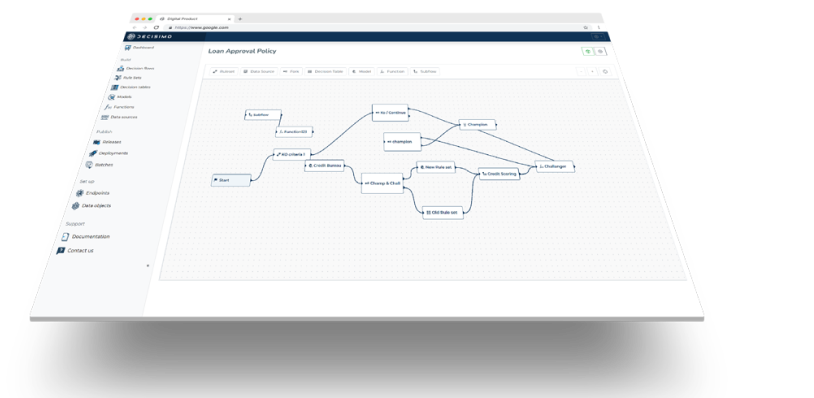
Rule Execution: The Operational Backbone
Optimizing Rule Execution for Performance
Rule execution is where decisions are made, and its efficiency affects overall system performance. Cloud-based engines use scalable infrastructure to handle changing loads efficiently, which helps maintain performance even under heavy demand.
Troubleshooting Common Rule Execution Issues
Troubleshooting is often simpler in cloud-based systems because they include advanced monitoring tools and support structures. That makes maintenance easier, shortens downtime, and improves reliability.
Historical Versioning and Accessibility
The fifth component is a usable history of the decision logic. Every version of each versioned object is recorded, including decision tables, decision trees, rule sets, scorecards, custom functions, models, policy requirements, case types and decision flows. A revision identifies the object, the person who saved it, when it was saved and the content checksum.
That history is available from the entity’s settings menu in the portal. A risk or operations colleague can open one revision on its own, or select a left and right revision to compare them side by side. This makes it possible to inspect what the logic was at a particular point, then review how its definition changed.
Version history and releases answer different questions. A revision records a saved version of an object. A release preserves the compiled snapshot of the whole decision flow that ran. If the underlying rule set is edited later, the released snapshot still shows which decision flow was used for that execution.
Compare the logic that changed
Revision comparison gives the team a direct way to examine two versions together. You can review the earlier and later definitions, or open a single version when the question concerns one specific point in the history. The result is a clearer record of what was changed before a decision flow is reviewed or managed.
Trace a decision to its version
The audit log connects a change to the person who made it and to the exact revision involved. The release then connects execution to the compiled decision flow that ran. Together, these records let the team see the logic, identify who changed it and distinguish the current definition from what actually ran.
Testing: the +1 alongside the five components
The five components describe what a rule engine architecture is: where decision logic is stored, how the underwriting team manages it, how releases are prepared, how decisions are executed, and how earlier versions remain accessible. Testing is the +1 alongside those components. It shows whether the decision flow you built does what you meant before real applications reach it.
A draft decision flow can be run before release. The draft is compiled through the same path used for a release, so the test exercises the decision logic that would ship. This makes testing part of the decision flow’s design and release process, not a separate description of the architecture.
Test a decision flow with a saved vector or supplied input
A dry run starts with a saved test vector kept by the customer, or with an object supplied in the request. If the request names a vector that does not exist, the result reports an unknown vector. You can also stop after a chosen step. The test then covers that step and the steps feeding it, and reports the input contract for that scope: the attributes the decision flow will read.
Test rule sets and complete case designs
Rule sets can be tested independently, with the attributes they read loaded for the test. For broader testing, a whole file of cases can run through a released decision flow as a batch. Case designs have a separate sandbox that runs a case to completion inside the request, rather than creating a real queued case. Together, these options give the five architectural components a practical check: you can examine what you built before relying on it in live applications.
Future Trends in Rule Engine Architecture
Emerging Technologies and Their Impact
When you and your team assess how AI and machine learning are integrated into cloud-based rule engines, you are seeing decision systems change. These changes include:
- Put trained ML models directly in the decision flow and run them in Python, R or Julia for more adaptable, intelligent decisions.
- Run a large language model as a step in the same decision flow, using its result alongside the other steps.
- Run document OCR as a step in the decision flow through an OCR service configured by your team.
- Use LLM-based copilots to assist with building decision logic, setup and rule validation; a person reviews and approves any proposed change to decision logic.
This integration makes rule engines more adaptable and better able to handle complex decision processes with improved efficiency and accuracy.
Case work takes a reactive shape
A decision flow is a directed graph: you draw the order, and each part feeds the next. Case work takes a different shape. Tasks are not wired together in a fixed sequence. Instead, each task declares what it reads and what it produces.
Everything is written to a shared case file. The scheduler checks the case file and selects any task whose inputs are satisfied, whether that task is human or automatic. When new evidence arrives, any task that depends on it can become eligible again. Nobody needs to edit a sequence. Explore case work as a reactive model for organising evidence and decisions.
Preparing for Scalable and Flexible Architectures
When you and your team consider the future of rule engine architecture, scalability and flexibility remain central. Cloud-based systems are well suited to both, and they can adapt quickly as your organization grows and requirements change. For the people choosing the architecture, that highlights the advantage of cloud-based architecture over traditional, code-heavy setups.
Frequently asked questions
How should I scope a partial draft test?
Choose the decision point whose behavior you changed, then include its upstream dependencies in the dry run. Review the reported input contract and supply every attribute the scoped decision flow reads, including boundary values and missing-value cases. A partial run helps isolate a change, but it does not show that downstream logic or the complete released decision flow still behaves as intended.
Can I use a batch to test an unreleased draft against many applications?
Use a draft dry run for an individual saved test vector or supplied input. The batch option runs a file of cases through a released decision flow, so it does not validate an unreleased draft across that same file. For broader regression coverage, release through your normal controls, then batch the cases and compare the results with expected outcomes.
When should I use a saved test vector instead of supplying an input directly?
Use a saved vector when you want a repeatable check that colleagues can run again after a change. Supply an input directly when you need to probe a particular boundary or reproduce an input that is not in the saved set. Record the expected outcome with the test, because a successful run shows what the logic returned, not whether that result is correct.
How do you design a rule engine?
Design a rule engine by deciding where decision logic is stored and versioned, who creates, edits, and reviews rules, and how changes are released. A release preserves the compiled snapshot of the whole decision flow that ran, and a draft can be tested through the same compilation path using a saved test vector or supplied input. A draft test can stop after a chosen step.
What does a rule engine architecture diagram show?
A rule engine architecture diagram shows the rule repository, rule management interface, rule deployment interface, rule execution, and historical versioning, with testing as the +1. The diagram numbers these in that order and uses no arrows because no flow between the components is stated.
What is the difference between rule engine architecture and rules engine design patterns?
Rule engine architecture has five components: a rule repository, rule management and deployment interfaces, rule execution, and historical versioning. For how rules are structured as rule sets, decision tables, decision trees and decision flows, see rules engine design patterns.
