5 Important Components of Rule Engine Architecture
This article explains the five components of rule engine architecture that shape decision logic and operational control. It covers rule repositories, rule management and deployment interfaces, execution, and historical versioning for traceability and compliance.
Rule engine architecture is a core part of modern decision systems, especially in cloud environments. As companies rely more on automated processes for speed and accuracy, it becomes important to understand how this architecture works.
Overview of Rule Engine Architecture
Rule engines are used for automated decision-making across many use cases. Their value comes from how flexibly and efficiently they apply decision logic. The main components of rule engine architecture include:
- Rule Repository: The central place for storing and managing decision logic.
- User Interface for Rule Management: Functions for creating, editing, and reviewing rules.
- User Interface for Rule Deployment: Controls for releasing rule changes and applying them.
- Rule Execution: The process that applies rules to data to make decisions.
- Historical Versioning and Accessibility: When you or a colleague need to review or manage a rule, you can access a full history of its versions and changes.
When you and your team consider a rule engine for your work, these components, especially when hosted in the cloud, support the flexibility and efficiency that make rule engines useful across many industries, from data validation to complex decision processes.
Rule Repository: The Core of Rule Engines
Designing an Effective Rule Repository
The rule repository is the core store for decision logic, and it is central to how a rule engine works. An effective repository should:
- Store current rules and keep a full history of previous versions.
- Make it easy to access and review earlier versions, along with details of changes and the users who made them.
- Give you and your team easy scaling and reliable operation, which are common strengths of cloud-based systems.
These capabilities improve the repository and add transparency and control, which matter in complex decision environments.
Best Practices for Rule Repository Management
When you manage a rule repository, keeping it current is only part of your work. You also need to:
- Regular audits and performance checks to keep the repository efficient and effective.
- A setup that helps your team make fast, simple changes as decision environments change.
- When you manage the repository, tools in the user interface make the work easier and reduce the need for deep technical expertise.
Cloud-based platforms perform well in these areas. They provide advanced functions that simplify rule management. The system remains flexible and responsive to change.
User Interface for Rule Management
Key Features of Rule Management Interfaces
When you manage rules, you need a user interface that offers more than basic functionality. You need it to be clear and capable. The right interface should:
- Let the people managing your rules create, edit, and delete them easily; advanced programming skills are not required.
- Use a clear, logical layout so you can work through complex decision processes more easily.
- Keep the design simple while still supporting complex tasks.
Cloud-based interfaces often lead here by offering platforms that are easier to use and access. They reduce the learning curve and make rule management faster and less difficult.
Enhancing Usability in Rule Management Systems
When you and your team improve usability in rule management systems, you remove unnecessary complexity, and you do not limit capability. Good UI/UX in rule engines helps the people managing rules do this by:
- Let people with different levels of technical expertise manage rules.
- Use visual elements well so you and your colleagues can present complex logic in a clearer format.
- Adapting the interface to different user needs and preferences.
These points are often handled well in cloud-based systems, where the focus is on making powerful technology easier to use and preserving what the platform can do.
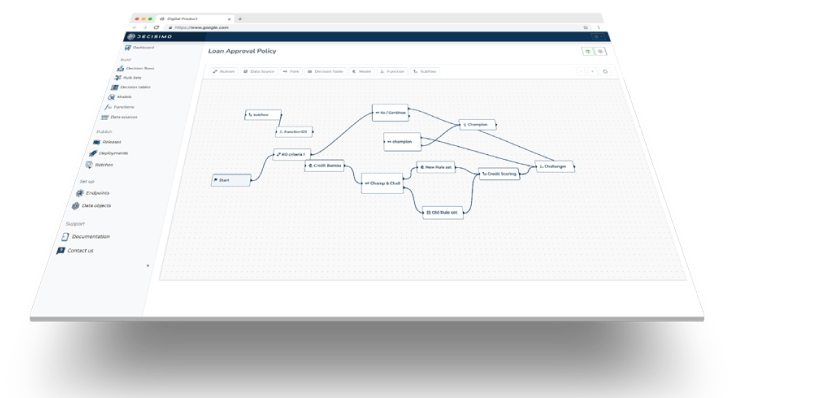
Deploying and Releasing New Rules: A User's Guide
Streamlining Rule Deployment Processes
Deploying new rules should be straightforward and should minimize disruption to operations. Cloud-based rule engines perform well here because they support fast integration and deployment. They can push changes across systems quickly without downtime, which is a clear advantage over traditional local setups.
Ensuring Consistency and Efficiency in Rule Release
Consistent rule deployment is important for system integrity and performance. Cloud-based engines provide a central framework that helps keep rule application uniform across all nodes, which is harder to achieve in traditional environments.
Rule Execution: The Operational Backbone
Optimizing Rule Execution for Performance
Rule execution is where decisions are made, and its efficiency affects overall system performance. Cloud-based engines use scalable infrastructure to handle changing loads efficiently, which helps maintain performance even under heavy demand.
Troubleshooting Common Rule Execution Issues
Troubleshooting is often simpler in cloud-based systems because they include advanced monitoring tools and support structures. That makes maintenance easier, shortens downtime, and improves reliability.
Future Trends in Rule Engine Architecture
Emerging Technologies and Their Impact
When you and your team assess how AI and machine learning are integrated into cloud-based rule engines, you are seeing decision systems change. These changes include:
- Higher levels of automation and intelligence.
- More adaptability and insight in rule engines.
- Your team can put ML models directly into the decision flow and run them in Python, R, or Julia.
- LLM-based copilots that assist with building decision logic, setup, and rule validation.
This integration makes rule engines more adaptable and better able to handle complex decision processes with improved efficiency and accuracy.
Preparing for Scalable and Flexible Architectures
When you and your team consider the future of rule engine architecture, scalability and flexibility remain central. Cloud-based systems are well suited to both, and they can adapt quickly as your organization grows and requirements change. For the people choosing the architecture, that highlights the advantage of cloud-based architecture over traditional, code-heavy setups.