Which South African affordability rule applies to SME loans
You are setting up the small-business product in your decision engine, with the credit policy document open beside the test queue. The affordability step has a single line: “affordability per NCA Reg 23A”. The first applications waiting are not variations on one borrower: a sole proprietor running a panel-beating shop, a private company asking for an overdraft, and a two-partner practice seeking a term loan. You can see the policy instruction and the application details, but the engine still needs a step that can sit between them. What does that line mean when you have to configure it for the businesses in front of you?
The NCA scope test and Reg 23A are separate decisions
The policy line is an understandable starting point: the National Credit Act generally applies to credit agreements, and Reg 23A applies to agreements covered by the Act. Join those statements into one instruction and every application appears to need the same affordability calculation.
The Act first determines whether the agreement is in scope. Reg 23A then sets an affordability calculation for agreements within its reach, with its own exclusions. A company can therefore fall under the Act and still be outside the Reg 23A route. Keep those decisions separate in the policy.
The same company can take different routes on different agreements
The company overdraft shows why the route must use both borrower and agreement details. A company with R640,000 turnover and R300,000 asset value falls outside the Act on a R400,000 term loan, and falls inside it on a R400,000 overdraft. On the overdraft route, the Act prescribes no affordability calculation under Part D, which contains the reckless-lending sections, or under Reg 23A.
| Borrower | Turnover | Agreement | NCA applies | Affordability | Why |
|---|---|---|---|---|---|
| Company | R4.2m | Term loan, R400,000 | No | Lender's own | s.4(1)(a) |
| Company | R640,000 | Term loan, R400,000 | No | Lender's own | s.4(1)(b), s.9(4)(b) |
| Company | R640,000 | Mortgage, R180,000 | No | Lender's own | s.4(1)(b), s.9(4)(a) |
| Company | R640,000 | Overdraft, R400,000 | Yes | Lender's own | s.78(1), Reg 23A(2) |
| Partnership | R800,000 | Term loan, R120,000 | Yes | Lender's own | s.78(1), Reg 23A(2) |
| Sole proprietor | any | Term loan, R120,000 | Yes | Reg 23A | s.81, Reg 23A |
| Sole proprietor | any | Term loan, R900,000 | Yes | Reg 23A | s.81, Reg 23A |
The sole proprietor’s R900,000 loan remains under the Act and takes the Reg 23A route, unless a regulatory exclusion applies. The partnership is a juristic person, so its R120,000 term loan is under the Act with no prescribed Reg 23A test.

Different borrowers and agreements produce different routes, even when the loan amounts look similar.
Classify the borrower before testing the agreement
A sole proprietor is a natural person. A partnership is a juristic person under the Act. A juristic borrower’s stated annual turnover or asset value at application determines whether it meets the R1 million threshold, with the corresponding figures of related juristic persons added. Either figure reaching the threshold takes the agreement outside the Act.

Once a juristic borrower falls below that threshold, the agreement type still matters. Every mortgage agreement is large, whatever its amount. An eligible other credit transaction is large when its principal debt reaches the higher threshold. A credit facility is classified separately, so an overdraft and a term loan for the same amount can fall on different sides of the Act.
The section 7 thresholds come from GN 713 of 2006. Use the agreement’s type and the amount relevant to that type when applying the large-agreement test.
Route applications by scope before choosing the affordability test
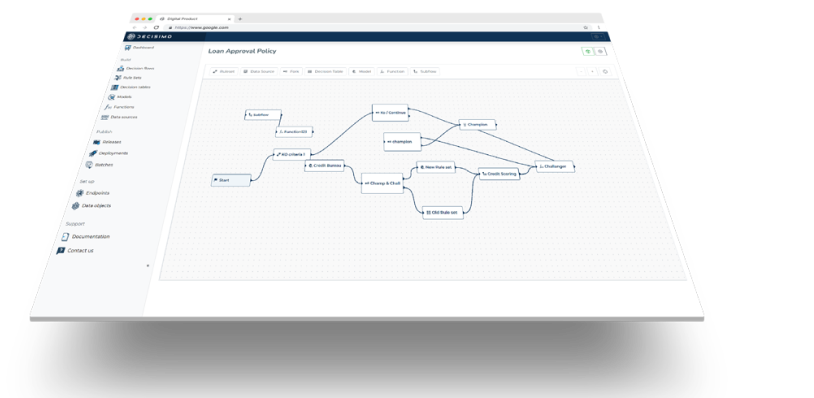
Make scope the first decision in the decision flow. Put the juristic-person threshold and large-agreement exclusions ahead of the row for other juristic borrowers. Then route natural persons to Reg 23A, subject to its exclusions. In a first-match decision table, the order of the rows determines which result applies.

A juristic borrower who remains inside the Act proceeds to the lender’s own business assessment. A natural person proceeds to Reg 23A unless an exclusion applies. Being inside the Act is only the first routing decision.
Calculate the Reg 23A route from income to the proposed instalment
The Reg 23A gazette requires gross income to be validated using evidence suited to the consumer’s circumstances. For a self-employed sole proprietor, the regulation allows the latest three months of bank statements or the latest financial statements. When monthly gross income shows material variance, use the average over at least the preceding three pay periods. The gazette does not define material variance. It specifies averaging over at least the preceding three pay periods when it occurs, rather than one method for every application.
Select the gross monthly income band in Table 1. Its minimum expense norm is the fixed amount plus the stated factor multiplied by gross income above the band minimum. Subtract statutory deductions and that norm to reach net income, then account for bureau-reported debt repayments, maintenance and other necessary expenses to reach discretionary income. The proposed instalment must fit within that amount.
| Income from | Income to | Fixed | Factor |
|---|---|---|---|
| R0.00 | R800.00 | R0.00 | 100% |
| R800.01 | R6,250.00 | R800.00 | 6.75% |
| R6,250.01 | R25,000.00 | R1,167.88 | 9.00% |
| R25,000.01 | R50,000.00 | R2,855.38 | 8.20% |
| R50,000.01 | Unlimited | R4,905.38 | 6.75% |
The worked example uses one sole proprietor’s income and obligations to compare two proposed instalments. The example shows the three-month average used in the calculation.
| Step | Amount |
|---|---|
| Gross income, three-month average | R38,000.00 |
| Band | R25,000.01 to R50,000 |
| Minimum expense norm: R2,855.38 + 8.2% x (R38,000 - R25,000) | R3,921.38 |
| Net income: R38,000 - R7,200 - R3,921.38 | R26,878.62 |
| Discretionary income: R26,878.62 - R6,500 | R20,378.62 |
| New instalment R4,000 (loan R120,000) | covered, pass |
| New instalment R22,000 (loan R900,000) | not covered, fail |

Use the resulting discretionary income in the context of the lender’s debt-to-income assessment. The affordability tool can help calculate it.
Assess an in-scope company against its repayment capacity
An in-scope company needs the lender’s own business assessment. The company overdraft in the test queue reaches that route. The scope decision alone says nothing about the company’s ability to repay.
Build the assessment around cash available for the proposed instalment. Read the company’s financial statements or management accounts alongside its bank statements, then test the cash flow against the instalment. Consider the business’s bureau record, the directors’ records, security and any suretyships as part of the lender’s policy.
Check the gazette before changing a live threshold or expense table
Keep the scope thresholds and Table 1 expense values in editable decision logic. When a gazette changes a value, identify exactly which rule it changes, update that value in the relevant table, and test the affected routes and calculations before release.
The section 7 figures checked are those in GN 713 of 2006. Our search found no later section 7 determination as of 20 October 2026. The 2016 notice changed the registration threshold, while the figures used for this scope test come from the 2006 notice. The 2025 amendment notice was a draft. Before changing a live rule, check the gazette for an effective change and confirm that it covers the value you intend to update.
Replace the policy line with a procedure that routes by borrower type
Return to the sole proprietor, company and partnership in your test queue. Replace the single instruction, “affordability per NCA Reg 23A”, with this sequence in your policy and decision logic:
- Capture whether each borrower is a natural or juristic person. For a juristic person, capture its stated turnover and asset value at application, and add the corresponding figures of related juristic persons.
- Capture whether the agreement is a mortgage, a credit facility and its limit, or another credit transaction and its principal debt.
- Route the application in one first-match decision table. Check the juristic-person threshold and large-agreement exclusions first. Route a remaining juristic borrower inside the Act to the lender’s own business assessment. Route a natural person to Reg 23A unless an exclusion applies.
- For a Reg 23A application, validate gross income and apply the averaging rule when material variance calls for it. Select the Table 1 band and calculate its minimum expense norm. Subtract statutory deductions and the norm to reach net income, then account for bureau instalments, maintenance and other necessary expenses to reach discretionary income. Pass only when that amount covers the proposed instalment.
- The lender’s own assessment checks business cash flow against the proposed instalment and considers the relevant business and director records, security and suretyships. Record the checks and their result.
- Keep the thresholds and expense table editable. Check the gazette before changing the live values, then test the affected routes and calculations.
Questions about NCA affordability for SME loans
Does the National Credit Act apply to loans to companies?
Yes, some company agreements fall under the Act. The route depends on the company’s stated turnover or asset value, related juristic persons’ corresponding figures, and the type and amount of the agreement. Apply those tests to each agreement.
Is the R1 million threshold about the loan or the borrower?
It is about a juristic borrower’s stated annual turnover or asset value at application, with the corresponding figures of related juristic persons added. Capture those figures separately from the loan amount.
Does Reg 23A apply to a sole proprietor’s business loan?
Generally, yes. A sole proprietor is a natural person, so the loan takes the Reg 23A route at any loan size unless a regulatory exclusion applies. Check the exclusions before calculating.
Do the reckless lending rules apply to a company borrower?
No. Part D, which includes the reckless-credit provisions and the assessment duty in sections 80 and 81, does not apply when the consumer is a juristic person. Keep the lender’s own company assessment distinct from the Reg 23A calculation.
What is a large agreement under the NCA?
A mortgage agreement is large at any amount. An eligible other credit transaction is large when its principal debt reaches the higher threshold. A credit facility is classified separately and does not become a large agreement on its own.
How is the minimum expense norm calculated?
Select the gross monthly income band in Table 1, then add its fixed amount to its factor multiplied by gross income above the band minimum. Keep the table values and the calculation rule editable.
Does the NCA cover a director’s suretyship for a company loan?
Section 4(2)(c) says the Act applies to a credit guarantee only to the extent that it applies to the underlying credit facility or transaction. Use that provision as the starting point and get the legal interpretation checked before encoding a guarantee-specific route.
Has Reg 23A changed since 2015?
No effective change was identified in the checks as of 20 October 2026. The 2025 amendment notice was a draft proposal. Check the gazette for an effective amendment before updating the live calculation.
