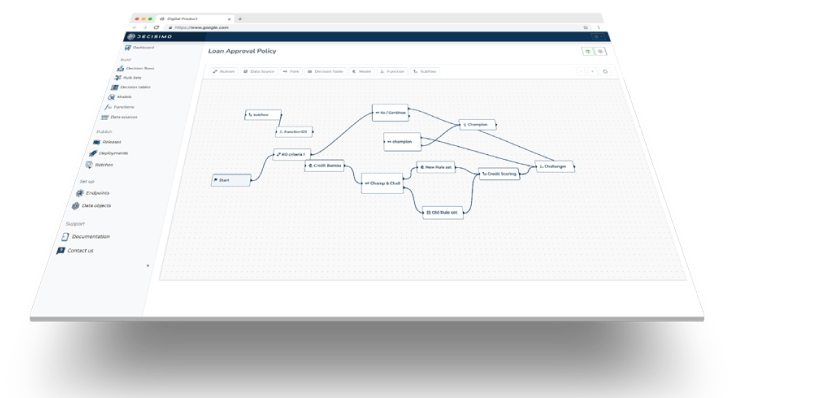
In consumer lending, decision-making centers on several areas: anti-fraud, loan underwriting, credit limit setting, cross-/up selling, portfolio management, and debt recovery. A data-driven company can automate each area with the help of a decision engine.
If you are new to consumer lending and plan to set up a consumer lending business, you can learn more from our overview.
This hub covers topics related to decision-making across key areas of consumer lending.
Anti fraud
Loan underwriting
Put these checks into a decision flow
Create rules for credit, fraud or collections, then run them on live decisions.
Portfolio management
Data Analytics
Frequently asked questions
What areas of consumer lending can a decision engine automate?
A decision engine can automate anti-fraud, loan underwriting, credit limit setting, cross-selling and up-selling, portfolio management, and debt recovery in consumer lending. These are key areas where consumer lending decisions are made.
What topics does consumer loan underwriting cover?
Consumer loan underwriting covers setting up the approval process and eligibility rules, risk-based pricing, and alternative data in credit scoring. Guidance can also cover replacing manual underwriting with automated decision logic.
What does portfolio management include in consumer lending?
Consumer lending portfolio management includes credit limit management and data analytics. Data analytics is one of the areas to cover in portfolio management, alongside decisions about credit limits. These topics form part of broader consumer lending decision-making.
Put these checks into a decision flow
Create rules for credit, fraud or collections, then run them on live decisions.
Related Articles
-
Metrics to Monitor in Lending and Credit Underwriting
Speed and conversion metrics shape how well a lender performs in underwriting. If you do not track the right ones, you can miss friction in the application flow, delay funding, and lose good customers before they reach a decision. This article explains four core underwriting metrics, how they differ, and why improving them gives lenders a real competitive edge.
-
Why segmented pre-collection activity matters for lending businesses
Segmented pre-collection helps lending businesses focus on accounts that need attention before they become delinquent. This article explains what pre-collection is, why segmentation matters, and the main ways lenders can use it to improve recovery without unnecessary contact with borrowers who are likely to pay on time.
-
MaxMind minFraud Factors: reason codes, pricing, and use
Factors returns the same score as Score and Insights when the three services are called at the same moment, plus reasons that show what raised or lowered it. The reasons are most useful when a score alone would leave an order inside your accept range.
-
Alternative data for credit scoring
Fintechs adopted alternative data for credit scoring first. Banks are now catching up. This article explains how alternative data can act as a proxy for credit history, and where that proxy fails: spurious correlations, seasonal effects, and weak causality. It also covers legal and discrimination risks, and the engineering work needed to turn unstructured signals into reliable AI and ML decision logic.
-
Simplify ML deployment with Decisimo: A clear platform for decision making - Decisimo
This article shows how Decisimo fits into ML deployment when you need more than a model endpoint. It explains how to build decision flows, connect models with rulesets and decision tables, and use Python or R outputs inside real decision logic for use cases such as credit scoring and risk-based pricing.

 Preventing Identity Fraud